Showing posts with label cognitive biases. Show all posts

Friday, March 16, 2018

Psychology for Writers: Knowledge and Perceived Competence

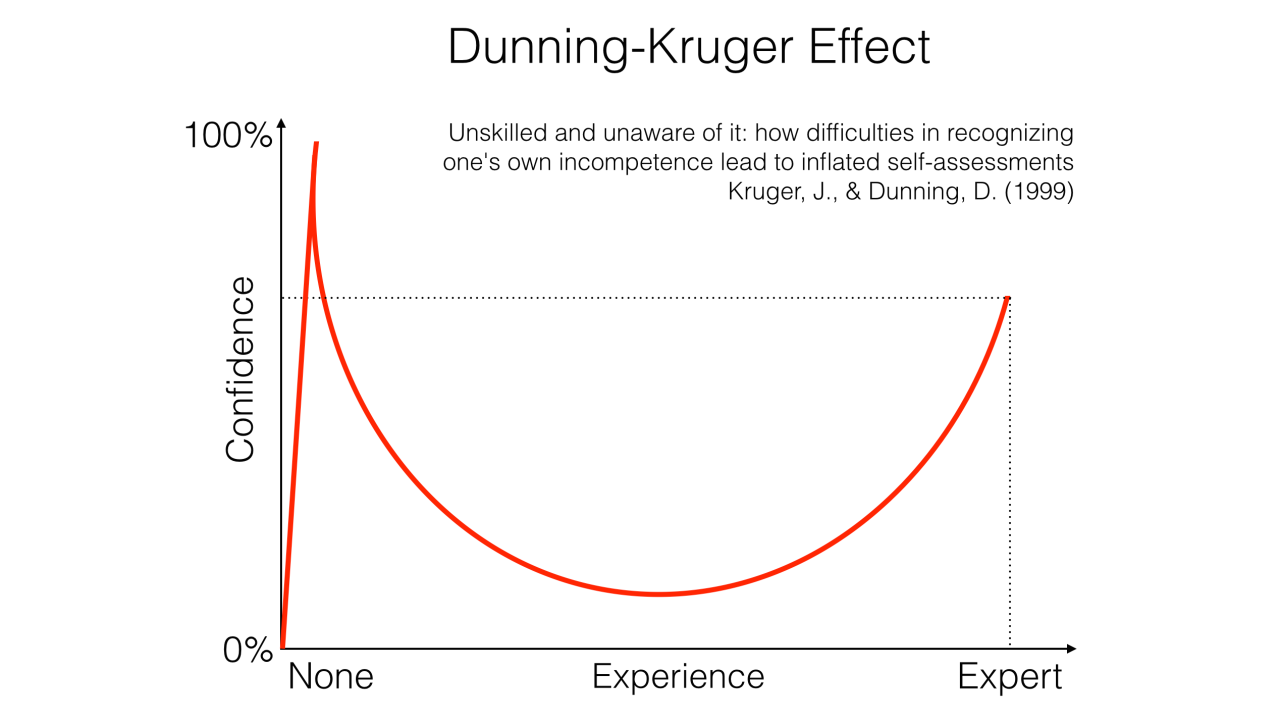
Every once in a while, a psychology theory comes along that is so good, I share it with pretty much everyone, not just fellow psychologists or the psychology-oriented friends. And a great example is the Dunning Kruger effect, which I've blogged about so many times. I share it again today, as a psychology for writers post because I think it is such a good descriptor of human behavior that it could easily influence how you write characters.

The Dunning Kruger effect describes the relationship between actual knowledge and perceived competence (how much knowledge you think you have or how well you know a topic). But to even begin to make accurate ratings on your own competence, you need to know enough about that topic, and, most importantly you need to know just how much you don't know.

If that description doesn't make sense, don't worry - I'm about to break things down. People who know very little about a topic and people who know a lot about a topic often rate their perceived competence very similarly. Why? People who know very little about a topic simply don't know enough to know how much there is to know on a topic. So they may underestimate how much work it takes to become an expert. In essence, they ask "How hard can it be?"

But people who have moderate levels of knowledge on a topic rate their competence much lower - lower than people with high levels of knowledge, yes, but also lower than people with low levels of knowledge. They now have enough knowledge on a topic to be aware of how much more work it would take to become an expert.

If you, like me, prefer to see things plotted out to make sense of them, I offer this graph from a Story.Fund post about the Dunning Kruger effect:


And if you'd like a real life example of the Dunning Kruger effect, I know of no better example than our President, who constantly speaks about topics he knows little about as though he were an expert.

What does this mean for your characters? It explains why complete beginners will often charge into something they know little about - and end up in over their heads. This happens a lot in fiction. But it also means that someone with a moderate amount of competence on something will be extremely cautious and not confident in their abilities. It could explain why someone chooses not to help that brash character that rushes in blindly - they don't have to be uncaring or even have poor self esteem to feel that way. They are simply more aware of their shortcomings and gaps in knowledge.

Tuesday, March 6, 2018

Today in "Evidence for the Dunning-Kruger Effect"

A new study shows that watching videos of people performing some skill can result in the illusion of skill acquisition, adding yet more evidence to the "how hard can it be?" mindset outlined in the Dunning-Kruger effect:
Although people may have good intentions when trying to learn by watching others, we explored unforeseen consequences of doing so: When people repeatedly watch others perform before ever attempting the skill themselves, they may overestimate the degree to which they can perform the skill, which is what we call an illusion of skill acquisition. This phenomenon is potentially important, because perceptions of learning likely guide choices about what skills to attempt and when.

In six experiments, we explored this hypothesis. First, we tested whether repeatedly watching others increases viewers’ belief that they can perform the skill themselves (Experiment 1). Next, we tested whether these perceptions are mistaken: Mere watching may not translate into better actual performance (Experiments 2–4). Finally, we tested mechanisms. Watching may inflate perceived learning because viewers believe that they have gained sufficient insight from tracking the performer’s actions alone (Experiment 5); conversely, experiencing a “taste” of the performance should attenuate the effect if it is indeed driven by the experiential gap between seeing and doing (Experiment 6).
In the experiments, participants watched videos of the tablecloth trick (pulling a tablecloth off a table without disturbing dishes; experiments 1 and 5), throwing darts (experiment 2), doing the moonwalk (experiment 3), mirror-tracing (tracing a path through a maze displayed at the top of the screen in a blank box just below it; experiment 4), and juggling bowling pins (experiment 6). Through their research, the authors isolated the missing element in learning by watching - feeling the actual performance of the task. In the 6th experiment, simply getting a taste of the feelings involved - holding the pins that would be used in juggling without attempting to juggle themselves - changed ratings of skill acquisition.

During the Olympics, when you watch athletes at the top of their game performing tasks almost effortlessly, it's easy to think the tasks aren't as challenging as they actually are. Based on these study results, even having people simply put on a pair of ice skates or stand on a snowboard might be enough for them to realize just how difficult skating can actually be.

Just to help put things into perspective, here's a supercut of awesome stunts followed by a person demonstrating why you should not try them at home:

Wednesday, February 7, 2018

Statistical Sins: Olympic Figure Skating and Biased Judges

The 2018 Winter Olympics are almost here! And, of course, everyone is already talking about the events that have me as mesmerized as the gymnasts in the Summer Olympics - figure skating.

Full confession: I love figure skating. (BTW, if you haven't yet seen I, Tonya, you really should. If for no other reason than Margot Robbie and Allison Janney.)

In fact, it seems everyone loves figure skating, so much that the sport is full of drama and scandals. And with the Winter Olympics almost here, people are already talking about the potential for biased judges.

We've long known that ratings from people are prone to biases. Some people are more lenient while others are more strict. We recognize that even with clear instructions on ratings, there is going to be bias. This is why in research we measure things like interrater reliability, and work to improve it when there are discrepancies between raters.

And if you've peeked at the current International Skating Union (ISU) Judging System, you'll note that the instructions are quite complex. They say the complexity is designed to prevent bias, but when one has to put so much cognitive effort into understanding something so complex, they have less cognitive energy to suppress things like bias. (That's right, this is a self-regulation and thought suppression issue - you only have so many cognitive resources to go around, and anything that monopolizes them will leave an opening for bias.)

Now, bias in terms of leniency and severity is not the real issue, though. If one judge tends to be more harsh and another tends to be more lenient, those tendencies should wash out thanks to averages. (In fact, total score is a trimmed mean, meaning they throw out the highest and lowest scores. A single very lenient judge and a single very harsh judge will then have no impact on a person's score.) The problem is when the bias emerges with certain people versus others.

At the 2014 Winter Olympics, the favorite to win was Yuna Kim of South Korea, who won the gold at the 2010 Winter Olympics. She skated beautifully; you can watch here. But she didn't win the gold, she won the silver. The gold went to Adelina Sotnikova of Russia (watch her routine here). The controversy is that, after her routine, she was greeted and hugged by the Russian judge. This was viewed by others as a clear sign of bias, and South Korea complained to the ISU. (The complaints were rejected, and the medals stood as awarded. After all, a single biased judge wouldn't have gotten Sotnikova such a high score; she had to have high scores across most, if not all, judges.) A researcher interviewed for NBC news conducted some statistical analysis of judge data and found an effect of judge country-of-origin:


As a psychometrician, judge ratings are a type of measurement, and I personally would approach this issue as a measurement problem. Rasch, the measurement model I use most regularly these days, posits that an individual's response to an item (or, in the figure skating world, a part of a routine) is a product of the difficulty of the item and the ability of the individual. If you read up on the ISU judging system (and I'll be honest - I don't completely understand it but I'm working on: perhaps for a Statistics Sunday post!), they do address this issue of difficulty in terms of the elements of the program: the jumps, spins, steps, and sequences skaters execute in their routine.

There are guidelines as to which/how many of the elements must be present in the routine and they are ranked in terms of difficulty, meaning that successfully executing a difficult element results in more points awarded than successfully executing an easy element (and failing to execute an easy element results in more points deducted than failing to execute a difficult element).

But a particular approach to Rasch allows the inclusion of other factors that might influence scores, such as judge. This model, which considers judge to be a "facet," can model judge bias, and thus allow it to be corrected when computing an individual's ability level. The bias at issue here is not just overall; it's related to the concordance between judge home country and skater home country. This effect can be easily modeled with a Rasch Facets model.

Of course, part of me feels the controversy at the beginning of the NBC article and video above is a bit overblown. The video fixates on an element Sotnikova blew - a difficult combination element (triple flip-double toe-double loop) she didn't quite execute perfectly. (She did land it though; she didn't fall.)

But the video does not show the easier element, a triple Lutz, that Kim didn't perfectly execute. (Once again, she landed it.) Admittedly, I only watched the medal-winning performances, and didn't see any of the earlier performances that might have shown Kim's superior skill and/or Sotnikova's supposed immaturity, but I could see, based on the concept of element difficulty, why one might have awarded Sotnikova more points than Kim, or at least, have deducted fewer points for Sotnikova's mistake than Kim's mistake.

In a future post, I plan to demonstrate how to conduct a Rasch model, and hopefully at some point a Facets model, maybe even using some figure skating judging data. The holdup is that I'd like to demonstrate it using R, since R is open source and accessible by any of my readers, as opposed to the proprietary software I use at my job (Winsteps for Rasch and Facets for Rasch Facets). I'd also like to do some QC between Winsteps/Facets and R packages, to check for potential inaccuracies in computing results, so that the package(s) I present have been validated first.
Thursday, November 2, 2017

Statistical Sins: Hello from the 'Other' Side

I'm currently analyzing data from our job analysis survey (in fact, look for a post in the near future about why it's important for psychometricians to remember how to solve systems of equations), and saved the analysis of demographics for last. Why? Because I'm fighting a battle with responses in the 'Other' category for some of these questions. I think I'm winning. Maybe.


I've blogged about survey design before. But I've never really discussed this concept of having an 'Other' category in your items. You assume when you write a survey that people will find a selection that matches their situation and for those few cases where no options match, you have 'Other' to capture those responses. You then ask people to specify why they are 'Other' so you can create additional categories to capture them in tables.

Or, you know, you could have what people actually do and end up with a bunch of people whose situation perfectly fits one of the existing categories and instead selects 'Other,' then writes an almost word-for-word version of an existing category in the specify box. For instance, in one item on our survey, we had 36 people select 'Other'. After I had looked at their responses and placed the ones that fit an existing category into that box, I had 7 'Other's left.

Actually, that's the second best outcome to hope for when allowing for 'Other.' More often, you get vaguely worded responses that could fit in any number of existing categories, if you only had the proper details. For example, in another item on our survey, I have 17 'Others.' I have no idea where to put two-thirds of them because they lack enough detail for me to choose between 2-3 existing options.

Fortunately, those two items are the standouts, and for remaining questions with 'Other' options, only 4-5 people selected them. Even for those few other responses that are gibberish, I'm not losing a lot of cases by calling them unclassifiable. But still, going through other responses is time consuming and requires a lot of judgement calls.

Obviously, what you want to do is minimize the number of 'Other' responses from the beginning. I know this is far easier said than done. But there are some tricks.

Get experts involved in the development of your survey. And I don't just mean experts in survey design (yes, those too, but...); I mean people with expertise in the topic being surveyed. Ask them what terms they use to describe these categories. And ask them what terms their coworkers and subordinates use to describe these categories. Find potential responses that are widely used and as unambiguous as possible. You'll still have a few stragglers who don't know the terms you're using, but you'll hopefully minimize your stragglers.

If possible, pilot test your survey with people who work in the field. And if your survey is very complex, consider doing cognitive interviews (look for a future blog post on that).

Find a balance in the number of options. What this really comes down to is balancing cognitive effort. You want to have enough to cover relevant situations, because that requires less cognitive effort from you when analyzing your data. You just run your descriptives and away we go.

But you also need to minimize response options to a number people can hold in memory at one time. The question above with the 17 other responses was also the question with the most response options. More isn't always better. Sometimes it's worse. I think for this item, we just got greedy about how much information and delineation we wanted in our responses. But if your response options become TL;DR, you'll get people skipping right to 'Other' because that requires less cognitive effort from them.

Balancing cognitive effort won't be 50/50. Someone is always going to pay with more cognitive effort than they'd like to exert and that someone should almost always be you. If you instead make your respondents pay with more effort than they'd like to exert, you end up with junk data or no data (because people stop completing the survey).

And of course, decide whether you care about other at all. If there are only a fixed number of situations and you think you have all of them addressed, you could try just dropping the other category altogether. Know that you'll probably have people skip the question as a result, if their situation isn't addressed. But if you only care to know if X, Y, or Z situations apply to respondents, that might be okay. This comes down to knowing your goal for every question you ask. If you're not really sure what the goal is of a question, maybe you don't need that question at all. As with number of response options, you also want to minimize the number of questions, by dropping any items that aren't essential. It's better to have 100 complete responses on fewer questions than 25 complete and 75 partial responses on more questions.

Friday, September 8, 2017

Is Networking Overrated?

This morning, I received my Friday email from the Association for Psychological Science, which includes links to media coverage of psychological science. The very first headline caught my eye: Good News for Young Strivers: Networking Is Overrated. As someone who dislikes networking, I was pleased to read in the first paragraph that many people find it distasteful - so distasteful that research shows people actually feel physically dirty after visualizing themselves networking. In fact, the column - written by Adam Grant, a professor at Wharton School - argues that networking doesn't help you accomplish great things. Rather, accomplishing great things helps you build a network:
Look at big breaks in entertainment. For George Lucas, a turning point was when Francis Ford Coppola hired him as a production assistant and went on to mentor him. Mr. Lucas didn’t schmooze his way into the relationship, though. As a film student he’d won first prize at a national festival and a scholarship to be an apprentice on a Warner Bros. film — he picked one of Mr. Coppola’s.

Networks help, of course. In a study of internet security start-ups, having a previous connection to an investor increased the odds of getting funded by that investor in the first year. But it was pretty much irrelevant afterward. Accomplishments were the dominant driver of who invested over time.
But as I got farther and farther along in the article, I couldn't help but think that he was making it sound too easy. I don't mean that working hard and being successful is easy. But it felt like he was brushing off all the people who lacked connections and the resources that some people are born into by saying, "Well, just be successful and the network will come to you." I couldn't completely figure out why I was so bothered by his article. Then he said this:
I don’t mean to suggest that success in any field is meritocratic. It’s dramatically easier to get credit for achievements and break into the elite if you’re male and white, your pedigree is full of fancy degrees and prestigious employers, you come from a family with wealth and connections, and you speak without a foreign accent. (Unless it’s a British accent, which has the uncanny ability to make you sound smart regardless of what words come out of your mouth.) But if you lack these status signals, it’s even more critical to produce a portfolio that proves your potential.
And that's when I realized what was bothering me. Sure, it's easy to say that if you don't have any of these privileged characteristics, you just need to work harder - something minorities and women have been hearing for a very long time. The problem is that 1) "success" and "achievement" are very subjective terms, and people may evaluate your achievements differently depending on your characteristics and 2) getting your achievements noticed also depends on your network. It's as though Professor Grant thinks there's a place where the powerful can go and peruse all the portfolios of young and successful people.

And sure, there are situations like that - his anecdote about George Lucas and the national festival is one place where you can go and see young people's work in the hopes of finding an up and coming director. But getting into film school, having the resources and training to create a product that gets attention, and then getting that attention from the judges are influenced by a person's background and privilege.

It feels as though Professor Grant is himself falling prey to the "myth of the self-made man." Anyone who says he (or she) is "self-made" is completely downplaying the influence of an environment conducive to success. Just like Donald Trump likes to downplay the financial help he received from his father to start his business.

In fact, here's a great example of how people evaluate success differently for young and hopeful entrepreneurs. Penelope Gazin and Kate Dwyer created a fake male cofounder to help launch their startup:
“When we were getting started, we were immediately faced with ‘Are you sure? Does this sound like a good idea?’,” says Dwyer. “I think because we’re young women, a lot of people looked at what we were doing like, ‘What a cute hobby!’ or ‘That’s a cute idea.'”

Regardless, the concept seems to be paying off. Witchsy, the alternative, curated marketplace for bizarre, culturally aware, and dark-humored art, celebrated its one-year anniversary this summer. The site, born out of frustration with the excessive clutter and limitations of bigger creative marketplaces like Etsy, peddles enamel pins, shirts, zines, art prints, handmade crafts and other wares from a stable of hand-selected artists. Witchsy eschews the “Live Laugh Love” vibe of knickknacks commonly found on sites like Etsy in favor of art that is at once darkly nihilistic and lightheartedly funny, ranging in spirit from fiercely feminist to obscene just for the fun of it.

After setting out to build Witchsy, it didn’t take long for them to notice a pattern: In many cases, the outside developers and graphic designers they enlisted to help often took a condescending tone over email. These collaborators, who were almost always male, were often short, slow to respond, and vaguely disrespectful in correspondence. In response to one request, a developer started an email with the words “Okay, girls…”

That’s when Gazin and Dwyer introduced a third cofounder: Keith Mann, an aptly named fictional character who could communicate with outsiders over email.

“It was like night and day,” says Dwyer. “It would take me days to get a response, but Keith could not only get a response and a status update, but also be asked if he wanted anything else or if there was anything else that Keith needed help with.”
It wasn't enough to have a good idea. It wasn't enough to prove they had the ability to execute it. It literally took emails with a man's name attached to get their business going. Success is never achieved in a vacuum, and even if it were, those characteristics Professor Grant highlights as making it "easier to get credit" can influence whether that vacuum is beneficent or hostile.

Tuesday, August 29, 2017

Social Learning and Amazon Reviews

In my inbox this morning was a new article from Psychological Science exploring how people use statistical and social information. And a great way to examine that is through Amazon reviews.

Social learning - also called vicarious learning - is when we learn by watching others. One of the famous social learning studies, Bandura's "bobo doll" study found that kids could learn vicariously by watching a recording, showing us that it isn't necessary for the learner to be in the same room as the model. The internet has exponentially increased our access to social information. But Amazon reviews not only provide social information, but numerical information:
One can learn in detail about the outcomes of others’ decisions by reading their reviews and can also learn more generally from average scores. However, making use of this information demands additional skills: notably, the ability to make intuitive statistical inferences from summary data, such as average review scores, and to integrate summary data with prior knowledge about the distribution of review scores across products.
To generate material for their studies, they examined data from 15 million Amazon reviews (15,655,439 reviews of 356,619 products, each with at least 5 reviews, to be exact). They don't provide a lot of detail in the article, instead referring to other sources, one of which is available here, to describe how these data were collected and analyzed. (tl;dr is that they used data mining and machine learning.)

For experiment 1, people had to make 33 forced choices between two products, which were presented along with an average rating and number of reviews. Overall, the most reviewed product had 150 reviews and the least reviewed product had 25, with options fall between those two extremes. An example was shown in the article:


They found that people tended to prefer the product with more reviews more frequently than their statistical model (which factored in both number of reviews and rating) predicted. In short, they were drawn more to the large numbers than to the information the ratings were communicating.

Experiment 2 replicated the first experiment, except this time, they had participants make 25 forced choices, and decreased the spread of number of reviews: the minimum was 6 and the maximum was 26. Once again, people were drawn more to the number of reviews than the ratings. When they pooled results from the two experiments and examined them using meta-analysis techniques, they found that people unaffected by the drastic differences in number of reviews between experiment 1 and experiment 2. As the authors state in their discussion:
In many conditions, participants actually expressed a reliable preference for more-reviewed products even when the larger sample of reviews served to statistically confirm that a poorly rated product was indeed poor.
Obviously, crowd-sourcing information is a good thing, because, as we understand from the law of large numbers, data from a larger sample is expected to more closely reflect the true population value.

The problem is that people fixate on the amount of information and use that heuristic to guide their decision, rather than using what the information is telling them about quality. And there's a point of diminishing returns on sample size and amount of information. A statistic derived from 50 people is likely closer to the true population than a statistic derived from 5 people. But doubling your sample from 50 to 100 doesn't double the accuracy. There comes a point where more is not necessarily better, just, well, more. This is a more complex side of statistical inference, one the average layperson doesn't really get into.

And while we're on the subject of Amazon reviews, there's this hilarious trend where people write joke reviews on Amazon. You can read some of them here.

Monday, August 28, 2017

Arpaio and Shifting Survey Responses

On Friday, the President issued a pardon for former Maricopa County Sheriff Joe Arpaio. Since that announcement, stories about Arpaio and his history have filled my Facebook newsfeed. Perry Bacon, Jr., at FiveThirtyEight argues that this pardon is motivated by conservative identity politics. In his article, he links to a YouGov poll, citing that - as evidence of his arguments about conservative identity politics - opinions about the pardon fall along party lines. But there's something even more interesting in this YouGov poll: an exploration of framing and its impact on opinions:
On Thursday and Friday, before President Trump pardoned former Maricopa county Sheriff Joe Arpaio, YouGov polled 1,000 Americans about what they thought should be done. Before supplying any information about the details of the Arpaio case, 24% said they were in favor of a pardon and 37% were opposed.

However, this is the type of question where opinion can change quickly as the public learns more about the issue. Despite widespread media coverage and Trump's hint of a pardon on Tuesday, a majority of the public said they knew "little" or "nothing at all" about the Arpaio case. To see what might happen if people were exposed to arguments for and against the pardon--as will inevitably happen--we asked our sample whether they agreed or disagreed with pro and con arguments.

The pro-pardon wording was based on White House talking points. The anti-pardon statement mirrored language used by Arpaio’s opponents.
After hearing one of the two arguments, respondents were then exposed to the other, so that by the end of the poll, everyone had heard both sides. This is when the most pronounced party differences in opinion appeared:


Specifically, most of the movement was among respondents who had selected "Not Sure" in their initial opinion. Among Democrats and, to a lesser extent, Independents, these individuals moved to "Oppose." The opposite trend is observed among Republicans, though some people who were initially "Oppose" also appear to have moved to different columns.

This presents a problem with regard to surveying about these issues. When addressing issues that are not well known, or where limited facts are available, it makes sense to include some background in opinion polling. But this highlights an important methodological issue - the way an issue is framed will certainly have an impact on responses (we've known this for a while), but including the "whole story" with two sides of an argument could also impact opinions, by leading to a group polarization effect. Notice what pushed many respondents to the poles of the continuum (a continuum with Oppose on one end and Favor on the other) was not that this was an issue addressed by current administration - which is in itself very divisive - but instead was the use of a partisan issue (illegal immigration) in the background information.

As more and more issues are politicized, we're likely to see more and more of this group polarization effect. And that will make it even harder to find a common ground.

Sunday, July 23, 2017

Statistics Sunday: Statistics Reading Round-Up

I'm working on some future Statistics Sunday posts, so in the meantime, I thought I'd offer you some of the statistics books on my reading list these days.

Recently, I finished reading:

  • How to Lie with Statistics by Darrell Huff - a quick reading at 144 pages. Lots of good information, especially for people with little statistics knowledge, because it will help you be a better consumer of research information you encounter in the media. He doesn't really go into how probability can influence sampling, and focuses on bias from the original researchers rather than secondary sources sharing the research. But you'll still learn a lot and you can knock this book out in a couple sittings.
  • Statistics Gone Wrong: The Woefully Complete Guide by Alex Reinhart - this book grew out a project Reinhart did as an undergraduate, which he started before he had any statistics training whatsoever. He's now a PhD candidate. His statistics knowledge is a bit thin in some places, and he switches back and forth on a few issues, but his understanding of probability is excellent. I learned a lot from him.
  • Fooled by Randomness by Nassim Nicholas Taleb - this is one of the books from Taleb's Incerto series. I had two of the books on my reading list - this one and The Black Swan - so I went ahead and picked up the full set, since it was only a little more than $40. Taleb is a former trader, and talks about some of the cognitive biases that cause us to see systematic explanations for random events, using the financial industry to demonstrate key probability concepts. His writing is very readable - you feel like he's sitting across from you chatting.
I'm currently reading The Seven Pillars of Statistical Wisdom by Stephen M. Stigler. In it, Stigler breaks down the seven core concepts that influenced statistical thinking. Though they're basic concepts now, they were radical propositions at some time. For instance, the first pillar is aggregation - summarizing the data with a single number. We do this all the time now with descriptive statistics like the mean, but when it was first proposed, mathematicians saw it as throwing away data or worse, trusting bad data along with good data (good and bad of course being subjective concepts).

Once I'm finished with that, here's what's on deck:
Happy reading, everyone! Let me know if you decide to read one of these books - I'd love to hear your thoughts!

Monday, May 29, 2017

Sara's Week in Psychological Science: Conference Wrap-Up

I'm back from Boston and collecting my thoughts from the conference. I had a great time and made lots of great connections. While I didn't have a lot of visitors to my poster, I had some wonderful conversations with a few visitors and other presenters - quality over quantity. I'm also making some plans for the near future. Stay tuned: there are some big changes on the horizon I'll be announcing, starting later in the week.

In the meantime, I'm revisiting notes from talks I attended. One in particular presented a flip side of a concept I've blogged about a lot - the Dunning-Kruger effect. To refresh your memory, the Dunning-Kruger effect describes the relationship between actual and perceived competence. People who are actually low or high in competence tend to rate themselves more highly on perceived competence than people with a moderate level of competence - and this effect has been observed for a variety of skills.

The reason for this effect has to do with knowing what competence looks like. You need a certain level of knowledge about a subject to know what true competence looks like. People with moderate competence know quite a bit but also know how much more there is to learn. But people with low competence don't know enough to understand what competence looks like - in short, they don't know what they don't know. (In fact, you can read a summary of some of this research here, which I co-authored several years ago with my dissertation director, Linda Heath, and a fellow graduate student, Adam DeHoek.)

The way to counteract this effect is to show people what competence looks like. But one presentation at APS this year showed a negative side effect of this tactic. Todd Rogers from the Harvard Kennedy School presented data collected through Massively Open Online Courses (MOOCs - such as those you'd find listed on Coursera). These courses have high enrollment but also high attrition - for instance, it isn't unusual for a course to have an enrollment of 15,000 but only 5,000 who complete all assignments.

Even with 66.7% attrition, that's a lot of grading. So MOOCs deal with high enrollment using peer assessment. Students are randomly assigned to grade other students' assignments. In his study, Dr. Rogers looked at the effect of quality of randomly assigned essays on course completion.

He found that when students received high quality essays, they were significantly less likely to finish, than if they received low quality essays. A follow-up experiment, where participants were randomly assigned to receive multiple high quality or low quality essays, confirmed these results. When people are exposed to competence, their self-appraisals go down, mitigating the Dunning-Kruger effect. But now they're also less likely to try. Depending on the skill, this might be the desired outcome, but not always. Usually when you try to get people to make more accurate self-assessments, you aren't trying to make them give up entirely, but perhaps accept that they have more to learn.

So how can you counteract the Dunning-Kruger effect without also potentially reducing a person's self-efficacy? I'll need to revisit this question sometime, but share any thoughts you might have in the comments below!

In the meantime, I leave you with a photo I took while sightseeing in Boston:

Monday, May 22, 2017

Would You Like Fryes With That?: A Psychological Analysis of Fraud Victims

What started as an over-the-top music festival in the Bahamas ended up as a social media joke. The Frye Festival, which was supposed to take place in late April, was canceled - after guests had already started arriving:
On social media, where Fyre Festival had been sold as a selfie-taker’s paradise, accounts showed none of the aspirational A-lister excesses, with only sad sandwiches and free alcohol to placate the restless crowds. General disappointment soon turned to near-panic as the festival was canceled and attendees attempted to flee back to the mainland of Florida.

“Not one thing that was promised on the website was delivered,” said Shivi Kumar, 33, who works in technology sales in New York, and came with a handful of friends expecting the deluxe “lodge” package for which they had paid $3,500: four king size beds and a chic living room lounge. Instead Ms. Kumar and her crew were directed to a tent encampment. Some tents had beds, but some were still unfurnished. Directed by a festival employee to “grab a tent,” attendees started running, she said.

Now, they're under federal investigation for fraud. In hindsight, the whole thing is clearly a scam. Websites disappeared because designers weren't getting paid. Past customers of previous services complained that special offers never materialized. Not to mention hearing from disgruntled past employees and contractors. In fact, it's so clearly a scam, it's surprising anyone fell for it.

It's very easy for us to look at all of this information now, and come to the conclusion that it was a scam. The problem with hindsight is that it's always 20/20. The same cannot be said for foresight but that doesn't stop people from saying they would have known all along. This is called hindsight bias.

There's probably also some victim blaming going on here. How could these people not know any better? Had we been in the same situation, of course we would have known. We distance ourselves from the victims of this fraud, because it helps us feel more safe, more in control of our world. The same thing could never happen to use because we wouldn't let it.

It's easy to understand reactions after-the-fact. What's more interesting, I think, is to try to figure out what got the attendees and contractors to buy into this fraud to begin with. We ask incredulously, "What were they thinking?" But seriously - what were they thinking?

Human beings are social creatures. We have to be. In order for our species to survive in a hostile environment, it was necessary for us to band together. We formed groups, which became tribes, which become whole societies. And in order to survive in these social structures, it was necessary for to have some trust in the people around us. You could argue that trust is an evolutionarily selected trait in humans. Let's face it, if you don't trust anyone else, it's really unlikely that you're going to reproduce. You have to at least trust one person to do that (at least, if you're reproducing on purpose).

So now we have a species pre-disposed toward trusting others. But we don't give our trust to just anyone - rather, to people we perceive as having certain traits. The more charismatic the leader, the more likely we are to trust them. And if everyone else in our social group trusts a certain person, we're more likely to trust that person too, at least externally.

Internally we may be more skeptical. If we look at the results of the Milgram study, we find that many people reported after the fact feeling very uncomfortable with what they were doing. They even had doubts as to whether they were doing the right thing. But they continued shocking the learner nonetheless. Why? Because somebody in the lab coat, somebody they perceived as having expertise, told them to. This person knows better than me, so I'm just going to keep doing what they say. It doesn't matter whether they actually have any expertise. It's the perception of expertise. And that is something charismatic leaders can do. They can convince you that they know more than they actually do, that they are an expert in something that you are not an expert in. Mc Farland had people believing that he was an expert in entertainment, technology, and rubbing elbows with celebrities. He had people convinced that he could help them to do the same thing.

I'm sure there are some people who didn't trust him. But they went along with him anyway, because there were people who did believe him, who believed that he could do exactly what he said he was going to do, despite instances in the past where he had simply wasted other people's money. But that's the nature of conformity. At the very least, if everyone else is doing it, that makes us more likely to question why we aren't doing it too. Maybe the rest of the group knows something that we don't. Maybe we're misreading the situation.

In the 1950s, Solomon Asch conducted what he said was a study on perception, that was actually a study of conformity.  Actors who pretended to be fellow participants publicly selected what was clearly the wrong answer, to see if the true participant would do the same; 32% of participants conformed with the wrong answer every time across multiple trials, and 75% conformed at least once.

Obviously, there are some other cognitive fallacies occurring here and in similar scams. The sunk cost fallacy, for instance, would explain why people held onto the idea of the festival, especially if they kept paying into it over time. It's the same principle that keeps people pumping money into slot machines or staying in bad relationships - if I keep this up, eventually it will be worth it, and I've put in too much time, money, and/or effort to walk away now. That's what happens when something has a variable schedule of reinforcement. We learn from variable schedules that if you just keep it up, the reward will eventually come.

Combine the sunk cost fallacy with a charismatic leader, the promise of rubbing elbows with people we admire, and other members of our social group going along with it, and it's not surprising at all that people fell for this scam. The problem is that people are going to keep falling for it. The people who were hurt in this particular scam will probably learn their lesson and stay far away from McFarland and his endeavors. But there will always be others will fall for it. And they're unlikely to learn anything from the negative experience of their peers - they'll blame the victims, they'll insist they would have known all along, and they'll distance themselves from those who have been hurt. They'll think of them as the outgroup - people who aren't like them in the ways that matter - and ascribe negative characteristics to them.

There will always be people like McFarland. And there will always be people who fall for his song and dance.

Wednesday, May 3, 2017

The Oatmeal and the Backfire Effect

Stop what you're doing and check out this great cartoon from the Oatmeal, dealing the backfire effect, a psychological phenomenon where information that is contrary to your beliefs actually strengthens your beliefs.


This concept is also sometimes called attitude polarization or belief polarization. Think of your attitude or belief as falling on a continuum, in terms of things like strength or importance - after all, most social psychologists do. Let's say you have an attitude that falls at the far right, close to the maximum. Information from the left might actually push you even farther right, up to the maximum (the poles).

If your attitude is a bit more wishy-washy (somewhere in the middle), it might not take much to move you to one side or the other. So backfire effects are strongest among people with strongly held attitudes or beliefs - generally the people who are more likely to act on those beliefs. We know that attitudes and behavior have a tenuous connection, but that connection is strongest when the attitude is specific and strong (a core belief).

On a side note: I wonder what it says about me that none of the "mind-blowing" facts presented in the cartoon ruffled my feathers. Either I'm really chill about hearing new information that might conflict with my beliefs or I'm feeling apathetic these days. (Yes.)

Tuesday, May 2, 2017

Mental Illness and Art

By now, you've probably at least heard of, if not watched, 13 Reasons Why, a series on Netflix that chronicles a set of tapes created by Hannah Baker to explain why she committed suicide. These tapes make it to our protagonist, Clay Jensen, a friend of Hannah's, and we learn about the events taking place prior to and after her suicide. It was a difficult series for me to watch - I had a cousin who committed suicide after his 30th birthday party, which coincidentally was also the day I graduated college. I awoke the next day to the news. A friend of mine who also experienced a family suicide mentioned that she was meaning to watch the show, and I passed on some trigger warnings for her. It's a difficult show to watch for anyone, but for people who have experienced firsthand the grief displayed by the characters of the show, especially Hannah's parents, it can bring back many conflicting emotions.

I do mean to sit down and write a review of the show. I think I need a little more distance, because I know I'm still feeling through many of emotions the show triggered. One thing the show has done is, it has started to get people talking about mental illness. In fact, that's what good art does - gets people thinking and talking about the human condition. In fact, two articles have crossed my path today, dealing with negative emotions more broadly and mental illness specifically.

The first is an interview with psychologist Susan David, whose book Emotional Agility deals with the importance of negative emotions, including in workplace settings. She argues that negative emotions should not be suppressed, because they can provide important information for the feeler and his/her coworkers:
A core part of emotional agility is the idea that our emotions are critical; they help us and our organizations. For example, if a person is upset that their idea was stolen at work, that’s a sign that they value fairness. Instead of being good or bad emotions, we should see emotions as containing useful data.
Our moods can provide us with important information - in fact, we refer to this in psychology as the "mood as information effect." If we realize we're in a negative mood, we analyze the situation to see what the cause could be. This mood is an indicator that something isn't right. Of course, Dr. David is going beyond mood as information and discussing how those emotions could inform others about what the person values. Further - and I'm sure she goes into this in her book - suppressing emotions can lead to thought suppression effects, where the suppressed emotions become stronger and more salient. The cognitive stress of suppressing would also make it more difficult for a person to do their job, especially jobs that require more critical thinking.

The other article deals with mental illness among artists, and asks whether pain is necessary to create great art:
Artists are masochists. We revel in the beauty of pain more than any other profession in the world. It's an experience we create for our viewers that is almost palpable. And it is in this experience that we connect to each other, creating everlasting bonds with our audience.

Some of the world's greatest artists have documented their own struggles with mental health. From depression and anxiety to a wide range of psychological disorders, these are all real themes that will always remain in art.
The article, written by artist Melody Nieves, who has struggled with depression herself, includes many great works of art, some familiar and some likely not, that deal with different aspects of mental illness and emotional pain:

Friday, March 10, 2017

The Truth About Your Brain

I've blogged in the past about Ben Carson, and all the problems when he tries to demonstrate expertise in an area that isn't neuroscience or medicine more generally. So I'm surprisingly not surprised by this speech where he got a lot of things wrong about the human brain:
It remembers everything you’ve ever seen. Everything you’ve ever heard. I could take the oldest person here, make a hole right here on the side of the head, and put some depth electrodes into their hippocampus and stimulate, and they would be able to recite back to you verbatim a book they read 60 years ago. It’s all there; it doesn’t go away.
Ben, please stop. You're making everyone with a doctorate look bad.

Memory is tricky. Your brain isn't a recorder or a computer that commits everything that ever happens to you to some storage compartment. An electrode or hypnosis or sharp blow to the head won't suddenly make these instances come flooding back, and even if they did, those instances would probably be horribly inaccurate. Your brain is a complex organ inside an unbelievably complex system that allows us to navigate the world and have a semblance of self by actively interpreting what we encounter. It isn't the book we read that gets committed to memory - it's our brain's interpretation of it and how we connect it to previously learned information that (sometimes, not always) gets written to memory.

In fact, all our memories are interpretations, with our brain filling things in with previous experience and expectations. And it isn't just during encoding that mistakes can be introduced; it's during retrieval as well. Have you ever remembered a time in your past and somehow remember a person being there you didn't even know at the time? This happens to me a lot. There's no way I could have even known about that person then, let alone remember seeing them. But my present life gets mixed up with the past. It's a little like writing a paper and saving it to your computer only to find years later that it was accidentally merged with newer files. That's what your brain is like.

And a lot of research has shown how easy it is to implant false memories that feel just as - maybe more - real than actual memories.

Carson's speech was apparently extemporaneous, but still, when talking about something you've dedicated your life to, you should be able to talk off-the-cuff without resorting to misinformation and tropes from bad movies:

Tuesday, March 7, 2017

The Verdict on Racism and Sexism

I'm currently in an online discussion about whether we should continue singing music that is outdated at best and misogynist at worst. The verdict is still out on that one, but it's generating some interesting perspectives.

So it's interesting timing that these two things came across my inbox today:
  • The Supreme Court ruled that a Colorado man may get a new trial, due to racist comments by a juror during deliberations - it was a close to decision (5-3).
  • New research published in Psychological Science finds evidence of prejudice transfer; finding out a person is sexist leads to the perception that the person may also be racist (and vice versa). This "transfer" was mostly driven by the degree of social dominance (showing a strong preference for their in-group and comfort with social inequalities) demonstrated by the perpetrator.

Friday, February 17, 2017

The Truth, The Whole Truth, and Nothing But the Truth

Today has been dubbed the "Day of Facts," and people and organizations around the world are participating:
A relevant fact is a powerful thing. In that spirit, Friday, Feb. 17, has been dubbed the “Day of Facts” and 270 cultural institutions in the United States and 13 other countries have signed up to use Twitter, Facebook and other social media to share important facts.

“The idea is for libraries and museums and archives across the country and around the world to post mission-related content as a way of reassuring the public that, as institutions, we remain trusted sources of knowledge,” said Alex Teller, director of communications at the Newberry Library. “It reflects recognition among a number of different institutions that while our missions haven’t changed, they’ve taken on a new significance in an era of alternative facts.”
Here's one of the contributions from Robert Martin, emeritus curator of the Integrative Research Center at the Field Museum:


Obviously, spreading misinformation is bad, and we should always strive to only share things that are true, but as we know, that doesn't always happen. The problem is that, even people with the best of intentions, who repeat the misinformation in order to correct it and offer the truth, can still misinform people. People will often remember things they read, but not necessarily the source, and occasionally, if they read something that repeats a myth (stating explicitly that it's a myth), people will sometimes just remember that portion. So they walk away from an article intended to dispel that myth with a stronger belief that it is true. This results in misinformation continuing to be spread. I know I've done the same thing even here on this blog, and it pains me to think anyone would walk away from something I wrote with only the falsehood. So here's a list of psychology myths rewritten as facts:
  • You use 100% of your brain, and depend on both sides equally.
  • Memory is incredibly malleable, even being changed by the present. Every memory you have is likely inaccurate in small or big ways.
  • Déjà vu is a perfectly normal, non-clairvoyant experience.
  • There is little support that people have unique "learning styles."
  • Mental illness is likely to be caused by a combination of environmental factors and physiological factors.
  • The most subliminal messages can do is affect your mood, and there is a tenuous connection between mood and behavior.
  • Classical music might make your baby a music snob, but not a genius.
  • Lie detector tests measure physiological arousal only. The results have to be interpreted by a person, and people are really bad at guessing whether a person is lying.
  • You're more likely to be attracted to people who are similar to you.
  • Increases in the prevalence of autism are likely due to a better understanding of the disorder, resulting in better diagnosis (and less misdiagnosis). We're also more aware of it now, so it could just feel more prevalent than it used to be.
For more of today's activities, check out the Day of Facts hashtag on Twitter.

Thursday, January 19, 2017

A Post-Mortem on 2016 Election Coverage

Today, Nate Silver of FiveThirtyEight published the first in what will be a series about the 2016 election. Data scientists, stats-junkies, psychologists, and haters of bad journalism rejoice - there will be a lot of analysis of the polling data and how it was (mis)used, cognitive biases, and journalistic errors in these pieces:
At this point, I don’t expect to convince anyone about the rightness or wrongness of FiveThirtyEight’s general election forecast. To some of you, a forecast that showed Trump with about a 30 percent chance of winning when the consensus view was that his chances were around 15 percent will self-evidently seem smart. To others, it will seem foolish. But for better or worse, what we’re saying here isn’t just hindsight bias. If you go back and check our coverage, you’ll see that most of these points are things that FiveThirtyEight (and sometimes also other data-friendly news sites) raised throughout the campaign.

With that in mind, here’s ground rule No. 1: These articles will focus on the general election.

Ground rule No. 2: These articles will mostly critique how conventional horse-race journalism assessed the election, although with several exceptions. The focus on conventional journalism in this article is not meant to imply that data journalists got everything right, however. There’s obviously a lot to criticize in how certain statistical models were designed, for instance.

Interestingly enough, the analytical errors made by reporters covering the campaign often mirrored those made by the modelers. I’d also argue that data journalists are increasingly making some of the same non-analytical errors as traditional journalists, such as using social media in a way that tends to suppress reasonable dissenting opinion.
I'll admit, I made some of the same mistakes to which he alludes in his articles, and I was following his model. Sometimes, it's difficult to separate the data from our opinions, especially opinions we really want to be right. This is the reason for different philosophies of science. While in a perfect world, we want researchers to study issues they have no strong opinions about, to ensure no bias, in reality, this is really difficult. People don't study things they care nothing about; doing research is hard work, and if you're not passionate about the issue, it's far too easy to throw up your hands when things get difficult. In fact, even studying something you really truly love, you'll get fatigued and will probably ending up hating it by the end - this is definitely true of thesis and dissertation topics.

In 2017, I resolve to be a better data scientist, and plan on building my skills in this vein. Stay tuned!

Tuesday, January 17, 2017

Are We Birds or Opposites?

One of my biggest pet peeves is when people tell me that psychological research findings are merely "common sense," which they tend to demonstrate with popular expressions. I usually resist the urge to school them on confirmation bias, though that's one of the cognitive biases they're exhibiting in such utterances. And instead point out times when common sense might tell us two contradictory things. For instance, a popular expression I hear a lot, with regard to research on similarity between friends and romantic partners is "Birds of a feather flock together." However, if I were to cite research showing that friends and romantic partners often differ in terms of personality, I would hear "Opposites attract." So, which is right?

A new article in Psychological Science sought to answer this question while counteracting biases in previous research. The problem is that in this area of research, we tend to rely on self-report and peer-report personality measures. And if people go into the study with expectations about what they think is true (i.e., are we birds or opposites?), that might bias how they respond. Instead, these researchers used behavioral measures of personality:
The first approach measured personality using a common type of digital footprint: Facebook Likes. Facebook users generate Likes by clicking a Like button on Facebook Pages related to products, famous people, books, etc. This feature allows users to express their preferences for a variety of content. It has been shown that Likes can be used to accurately assess people’s personality (Kosinski, Stillwell, & Graepel, 2013; Youyou, Kosinski, & Stillwell, 2015). For example, people who score high on Extraversion tend to Like “partying,” “dancing,” and celebrities.

The second approach measured personality using digital records of language use: Facebook status updates. Facebook users write status updates to share their thoughts, feelings, and life events with friends. Previous research has consistently found links between personality and language use (Hirsh & Peterson, 2009; Mehl, Gosling, & Pennebaker, 2006; Tausczik & Pennebaker, 2010). Extraverts, for example, tend to use more words describing positive emotions (e.g., “great,” “happy,” or “amazing”; H. A. Schwartz et al., 2013) than introverts do. Several studies have demonstrated accurate personality assessment based on people’s language use in social media (Farnadi et al., 2014; Sumner, Byers, Boochever, & Park, 2012), including Facebook status updates (Park et al., 2014; H. A. Schwartz et al., 2013).
Using data from the myPersonality Facebook application, which allows users to take various personality measures (so all participants had at least some self-report personality results), they built models using like data and status update language data. These models were then applied to a sample of dyads (pairs of friends or romantic partners). They found that dyads tend to be similar, and this is especially true for members of a romantic couple:
Our findings provide evidence that romantic partners as well as friends are characterized by similar personalities. We measured personality traits relying on three different sources of data: traditional self-report questionnaires, digital records of behaviors and preferences, and language use. Relatively strong similarity was detected between romantic partners and between friends when we used Likes-based and language-based measures. By contrast, self-reports yielded only weak to negligible similarity. Across all three methods, stronger personality similarity was found for romantic couples than for friends.
So based on this research, it seems we're birds.

Tuesday, December 20, 2016

More On Polling and Probability

Shortly after the election, I wrote a post with my thoughts on what happened with the polls, and why they failed to predict that Trump would win. One thing I mentioned is the tenuous connection between behavioral intention (what you plan to do) and behavior (what you actually do). That is, people who said they were planning to vote for Clinton changed their minds and voted for Trump instead. And some new work by Dan Hopkins and Diana Mutz suggests this may have been the case:
Our October 2016 wave was conducted with nationally sampled adults over age 26 between Oct. 14 and Oct. 24, meaning that it ended soon after the third Clinton-Trump debate. At the time, Clinton was riding high in the polls — and 43 percent of our panelists in that wave expressed support for Clinton, as opposed to 36 percent for Trump. By way of benchmarking, this same group of panelists had gone for President Obama over Mitt Romney 46 percent to 39 percent in October 2012.

And while most people’s support remained the same, the changes we did observe were consequential. Consider the table below, showing panelists’ support in the October 2016 poll versus their support in the post-election poll, which took place from Nov. 28 to Dec. 7. Eighty-nine percent of the 1,075 American adults reported the same preference in both waves, whether it was for Clinton (38.0 percent), Trump (35.2 percent) or neither (15.8 percent). But among those who did move, Trump had the advantage. While no one moved from Trump to Clinton, 0.9 percent of our respondents moved from Clinton to Trump. Although that 0.9 percent isn’t a lot, those changes are especially influential, since they simultaneously reduce Clinton’s tally and add to Trump’s. If there were a comparable swing in the national electorate, 1.2 million votes would move to Trump.

In all, Trump picked up 4.0 percentage points among people who hadn’t been with him in mid-October, and shed just 1.7 percentage points for a net gain of 2.3 points. Clinton picked up a smaller fraction — 2.3 points — and shed 4.0 points for a net loss of 1.7 points. That’s certainly consistent with Trump gaining steam in the race’s final weeks. Seeing as the 2016 election was held on the latest possible day given the mandate to hold it on the first Tuesday after the first Monday in November, we might just add the 2016 leap year to the ever-growing list of reasons why Trump prevailed.

So what could have changed voters' minds at the last minute, causing them to shift their support? Hmm, I might have some ideas.

Saturday, December 17, 2016

Want to Give Better Gifts?: Lessons from Psychological Science

In my email today was a link to this article, which explains why some people give really awful gifts without even realizing it:
In this review, we propose that many giver-recipient discrepancies can be at least partially explained by the notion that when evaluating the quality of a gift, givers primarily focus on the moment of the exchange, whereas recipients instead mostly focus on how valuable a gift will be throughout their ownership of it. Givers and receivers have different perspectives on what makes a gift “valuable”: Givers interpret that to mean that the gift will make the recipient feel delighted, impressed, surprised, and/or touched when he or she receives and opens it, whereas recipients find value in factors that allow them to better utilize and enjoy a gift during their subsequent ownership of it.
So part of the trick to buying good gifts for people is to put yourself in their shoes. Think about what it would be like if someone gave you that gift. Would you actually use it? Or would it gather dust, be regifted, or worse yet, end up in the trash? I'm sure I'm guilty of giving some really awful gifts to people because I didn't stop and consider this issue. What has probably worked best for me, especially when buying gifts for people I don't know as well, is to think of something they said recently - a hint about something they would really enjoy.

Or, if all else fails, I give them something I would want for myself and just hope for the best.


Tuesday, December 13, 2016

Commentary on the American Divide from David Myers

If you took Introductory Psychology or Social Psychology, it's quite possible your textbook was by David Myers, who in addition to writing textbooks and researching psychological topics, maintains a blog called "Talk Psych." Yesterday, Dr. Myers discussed recent Gallup poll results showing that 77% of Americans perceive our nation to be divided:

All major subgroups of Americans share the view that the nation is divided, though Republicans (68%) are less likely to believe this than independents (78%) and Democrats (83%). That is consistent with the findings in the past two polls, conducted after the 2004 and 2012 presidential elections, in which the winning party's supporters were less likely to perceive the nation as divided.

Americans are split about evenly on whether Trump will do more to unite the country (45%) or do more to divide it (49%). These views largely follow party lines, with 88% of Republicans believing Trump will do more to unite the country and 81% of Democrats saying he will do more to divide it. Independents predict Trump will do more to divide (51%) than to unite the country (43%).
In fact, the most recent time that Americans believed America was more united than divided was following the 9/11 attacks, which psychological theorists argued prompted unity through a concept known as terror management theory: we respond to existential threat (reminders that we are mortal and will die, known as mortality salience) by strengthening our ties to others and reaffirming our identities. This was how many explained, for instance, the upswing in flag display and other symbols of our country (in fact, see a previous post on these concepts).

David Myers offers a social psychological explanation for this "record-high" in perceptions of division:
A powerful principle helps explain today’s deep divisions: The beliefs and attitudes we bring to a group grow stronger as we discuss them with like-minded others. This process, known to social psychologists as group polarization, can work for good. Peacemakers, cancer patients, and disability advocates gain strength from kindred spirits. In one of my own studies, low-prejudice students became even more accepting while discussing racial issues. But group polarization can also be toxic, as we observed when high-prejudice students became more prejudiced after discussion with one another. The repeated finding from experiments on group interaction: Opinion-diversity moderates views; like minds polarize further.

Group polarization feeds extremism. Analyses of terrorist organizations reveal that the terrorist mentality usually emerges slowly, among people who share a grievance. As they interact in isolation (sometimes with other “brothers” and “sisters” in camps or in prisons), their views grow more extreme. Increasingly, they categorize the world as “us” against “them.” Separation + conversation = polarization.

The Internet offers us a connected global world without walls, yet also provides a fertile medium for group polarization. Progressives friend progressives and share links to sites that affirm their shared views and that disparage those they despise. Conservatives connect with conservatives and likewise share conservative perspectives.
The very forces and media intended to bring us together can actually drive us apart.