Showing posts with label review. Show all posts

Thursday, April 1, 2021

Noise in the Middle: Movie Review

I've been on a horror movie kick for a while (as I've said before particularly here and here, I love a good horror movie, and I also think that after the last year+ of insanity, nothing really scares me anymore, or at least fiction doesn't scare me more than reality). I've been checking out every horror movie I can find on my various streaming services and, well, I've definitely watched some crappy ones. Maybe I'll blog about them sometime.

This evening, I watched Noise in the Middle, the story of a grieving widow and his daughter with severe autism, who seek out an experimental treatment (what appears to be transcranial magnetic stimulation therapy or something like it). What he doesn't realize is that the house he rents is haunted by an occult-loving sadist and the ghosts of the children from his poor house/orphanage that he bound to be trapped in the house after their death. Or something. It's not completely clear but it apparently involved branding the children with an infinity symbol and also the children killing him and themselves with a fire. Or something. 

The concept was promising - although I find the "kid with autism has special powers (in this case, is a conduit and can see spirits)" concept to be problematic, just like I found the "woman with dementia is actually possessed" concept to be problematic in The Taking of Deborah Logan - and the movie started off great. We established the background, got some ominous shots and glowing eyes in dark rooms. We also saw some really interesting symbolic imagery after Emmy's (the daughter) treatments with TMS, very Ring-video type images, which could have been used more fully in connection with the haunted house and the concept but sadly was not. We even had the "person randomly finds occult shop/enthusiast who believes the main character and helps them" trope used for more humorous and uplifting effect. 

In the middle, things began to drag and become more convoluted, which I thought might be used to tie in the symbolic imagery from Emmy's sessions, but sadly was not. The end was just a big old mess. It felt like the writer had a great idea, spent lots of time on the beginning, lost steam in the middle, and then had to just finish the damn thing by the end. The movie toyed with so many horror concepts (haunted house starts to bring out the darkness in/infect the father, like The Shining; seemingly random images have more concrete meaning for the mystery, like Ringu/The Ring; grief manifested as a spirit or entity, like The Babadook) but never really fully committed to any of it.

Overall, I'd say don't bother with this one. The beginning made me have high expectations that this movie would be good/meaningful/even a little scary, but I ended up with "WTF did I just watch and why?". 

Monday, January 4, 2021

My Dark Vanessa: Book Review

Content Warning: sexual abuse, child abuse, and rape

Earlier today, I finished My Dark Vanessa, a debut novel by Kate Elizabeth Russell. The book is told by Vanessa Wye, a young woman who was abused by her boarding school English teacher starting when she was 15. The book spans 17 years, jumping between Vanessa's youth and adulthood. Before I get into my (slightly spoiler-y) review, I want to say: I loved this book, and I also have no desire to ever read it again.

As you can imagine from the title and brief synopsis, this a difficult book, as we hear everything that happened in the mind of a young woman who was gaslighted into believing she had all the power in situations when she had almost none and at the same time, that she had no power in situations where she could do something to stop the abuse. It's a deep and disturbing dive into the way an older man selects and grooms his victim, changing her thinking and behavior for decades, and convincing her that she's a willing participant, even when she describes very clear dissociation (being outside of herself) during the episodes of abuse - a reaction often seen in victims of child abuse.

The book also digs into two really key issues, that I haven't often seen explored or explored this well: 1. The narrative that women have "feminine gifts" that allow them to have power over a man, and make these men do things they wouldn't otherwise do. And 2. That coming forward is the only responsible thing a victim of such abuse can do.

The first issue (the "power" of femininity to take away men's agency) is such a pervasive part of rape culture. But this book also explores how this narrative has been romanticized to even apply to situations of a very young girl and a much older man, in stories like Lolita, American Beauty, and Pretty Baby. It is this romanticization and narrative that makes Vanessa continue her relationship with her abuser, Jacob Strane, even when it actively hurts her. He convinces her that he has so much more to lose than she does if their "love" becomes public, that he cannot help himself, that she has the power in the situation to consent or decline (even when he ignores her requests for him to stop and/or fails to ask for consent for very extreme sexual acts), and that, most of all, she is special because of this power she has. For a lonely girl, away from home for the first time, it's so easy to see how he selects and grooms her. But perhaps one of the most frustrating things is, even as I was reading and feeling what Vanessa feels, the descriptions and behaviors were so clear, I would shout at her as I read that there's some textbook-level gaslighting going on. It's why this is such a good book - that the author can give us those really clear cues while still telling the book in first-person, and avoid the "unreliable narrator" trope - and also one I hope to never read again.

This narrative of feminine wiles is perhaps ones of biggest issues we need to contend with if we want to do away with rape culture for good. It's a narrative that, on its surface, appears to assign all the power to the woman and none to her rapist or abuser, when at its core, it instead makes the woman powerless to stop (and deserving of) whatever harm is done to her. It's also a narrative that can be so easily spun as a positive thing when it is actually toxic and harmful. 

The second issue is a bit more ambiguous, at least for me, because before I read this book, I would have agreed with this second statement, that victims must come forward so that the abuser can be brought to justice and that others can be protected. I believed this even as a person who did not bring my own rapist to justice, something I was very ashamed of about myself. But this book made me realize just how tricky this issue is. 

At a surface level, it seems like a conflict between the needs of the individual and the needs of many, and from a philosophical standpoint, the needs of the many should outweigh the needs of the individual. But framing it in such a way takes away the individual's autonomy, a major issue considering that the abuse/rape was all about taking away one individual's autonomy. And victims already feel a great deal of guilt and self-blame for the event; they don't need the guilt of believing they failed others, or that they are in some way responsible for the reprehensible actions of another. 

Framing it as needs of the individual vs. needs of the many oversimplifies exactly what the needs of the individuals are (privacy, self-care, fear of reprisals, and so on), while also making that individual an accomplice in how another person's actions affects the many. In the case of adults in positions of power abusing the people they should be protecting, no victim should ever be to blame; this is on the system that put (and often helps to keep) that person in power, and on all of us, for the ways (big and small) that we may contribute to these power dynamics and rape culture.

This book was very triggering for me (even though my personal experiences do not resemble Vanessa), and I'm still working through the emotions it's brought up. I was reminded of a book I read in college, Bastard Out of Carolina, which also details years of sexual abuse of a child. When I finished that book, I threw it against the wall. Fortunately this book didn't elicit that reaction, but I didn't have a super-positive reaction to the ending either. 

I'm still glad I read it, though I probably wouldn't recommend it to anyone who might also be triggered, especially if they haven't been able to work through their own trauma through therapy or treatment. And I'll definitely keep an eye out for future books by Kate Elizabeth Russell.

Saturday, August 15, 2020

Pets and Quarantine

I'm so thankful to have my sweet boy, Zeppelin, in my life. And when quarantine/shelter-in-place began, I was especially thankful to have him, because otherwise, I would have been completely alone. Unsurprisingly, a recent study found I'm not the only one to feel this way:

Animal shelters across the country are being completely cleared out as people seek out creature comfort. In fact, more than one in four 18-37-year-olds with pets got their new friend during quarantine.1 Pets are bringing much-needed doses of positivity: two-thirds of Gen Z and Millennials living with pets agree their pet has helped them stay positive during this time.1

Pets are not only showing up in homes—we are seeing them brighten up our feeds, too. Online conversation around pet adoption spiked in mid-March, up 50% from the weekly average.5 Whether they have a furry friend or not, 80% of Gen Z and Millennials say seeing animal content on social media makes them happy, and 74% agree that they find comfort in animal content on social media.1 Additionally, pet-related hashtags such as #MeetMyPet, #PetRoutine, and #TreatYourPet have been trending on TikTok throughout the pandemic.

In fact, 68% of respondents said their pet helped them feel less alone, 65% said their pet helped them to "stay sane" during the pandemic, 54% believe having a pet has made them be healthier, and 39% said they'd been talking to their pet more during quarantine (guilty).

If you wish you had a four-legged friend during this difficult time, there are tons in need of a good home! I'm so glad this sweet guy is part of mine:


Tuesday, August 11, 2020

Coronavirus "Truthers" and Men Without Masks

Two articles related to coronavirus crossed my newsfeed this morning. First is an inside look at the various Coronavirus "Truth" sites on Facebook, which peddle a variety of misinformation - from the argument that mask-wearing is a prelude to the imposition of Sharia law to masks as a way to increase child sex trafficking:

Just searching “coronavirus” will take you to a host of legitimate resources: pages for the CDC, the World Health Organization and the American Medical Association. But add a word like “truth” and suddenly you’re on a different planet: groups that exist as safe spaces for coronavirus skeptics to share theories of what’s really going on.

For every post or meme that bears a “False Information” label and links to fact-checking sites, there are dozens that elude this moderation, often as they do not present a debunkable statement. How exactly are you supposed to disprove the notion that face-mask enforcement is a prelude to some requirement that women wear the Muslim niqab?

The misinformation is so diversified (yet interconnected and overlapping) that you are bound to find your personal bogeyman at the bottom of the rabbit hole. These memes and talking points are made to frighten while appealing to your “common sense,” to flatter your intellect as it suckers you in with specious “logic” and emotional whataboutery.

Sadly, I've seen a lot of these memes and specious arguments on the pages of friends and acquaintances.

The second article discusses research that attempts to explain why men are being hit harder with Coronavirus: performative masculinity:

Poll after poll, most recently a Gallup poll from July 13, has found American men are more likely to not wear masks compared to women. Specifically, the survey found that 34 percent of men compared to 54 percent of women responded they “always” wore a mask when outside their home and that 20 percent of men said they “never” wore a mask outside their home (compared to just 8 percent of women).

Tyler Reny, a postdoctoral research fellow at Washington University in St. Louis, found [similar results] by combing through data from the Democracy Fund + UCLA Nationscape project, a public opinion survey that’s been interviewing more than 6,000 Americans about the virus per week since March 19.

“Those who had more sexist attitudes were far less likely to report feeling concerned about the pandemic, less likely to support state and local coronavirus policies, less likely to take precautions like washing their hands or wearing masks, and more likely to get sick than those with less sexist attitudes,” Reny told me. “What I found is that sexist attitudes are very predictive of all four sets of [aforementioned] outcomes, even after accounting for differences in partisanship, ideology, age, education, and population density.”

Stay healthy, stay informed, and please:

Wednesday, June 10, 2020

Space Force: A Review

I've continued to work from home during our shelter-in-place (something my boss recently told me we'll be doing for a while). During my copious downtime, I've gotten to watch a lot of things I've had on my watch-list, including the Netflix original series, Space Force.


I've made my way through season 1 of the series, and thoroughly enjoyed it. I was surprised to learn - partway through watching - that critics did not enjoy the series nearly as much as I did. I'll get to that shortly.

I loved the political satire element of the show, that it was inspired by statements by our buffoon of a president. And I loved the periodic texts and tweets they referenced from a character they only referred to as "POTUS" (although, we all know who they mean). But really, I felt the critics were expecting something very different from what the show gave us, and that is the reason for their negative review.

While the concept is hilarious, and Mark Naird (Steve Carrell's character) is often a buffoon, the show is really a family drama framed by absurdist comedy. General Naird is a single father of a teenage daughter (Diana Silver, from Booksmart, which I also thoroughly enjoyed), after his wife (played brilliantly by Lisa Kudrow) is imprisoned for an unmentioned crime (which earned her 40-60 years, so clearly really bad). The show deals with a variety of family issues, not just the aforementioned single parenthood, but also teenage rebellion and substance abuse, fear of abandonment, and a parent who often feels married to their job. It dealt with the concept of an open marriage in a way that was authentic, while also being heartbreaking and funny at the same time. The show made me cry just as often as it made me laugh, and I could often relate to Mark's character - his heartbreak when his wife suggested an open marriage was so real, I bawled. It poked fun at the full political spectrum, as well as at Boomers, X-ers, and Millennials alike.

I think a lot of people were expecting Michael Scott as a general, but Mark Naird - though often a goof who really didn't understand science, which was an important part of his job, personified by his chief scientist (played so wonderfully by John Malkovich: better casting does not exist) - showed a surprising depth and understanding of people, in ways that both surprised and confirmed the conclusions of his scientists. Michael Scott seemed oblivious to the people who worked from him and showed zero understanding of people skills, while Mark Naird thought first and foremost about the people, and spoke eloquently on the topic.

I especially loved the character of Captain Ali (played by Tawny Newsome) and look forward (hopefully) to learning more about her character. Of all the characters on the show, she's my favorite.

It was also a joy to see Fred Willard as Mark's elderly father, who since filming his role has passed away. He will very much be missed and I'll be interested in seeing how they deal with the actor's death (since season 2 has not even been greenlit, let alone filmed). My only complaint was with the cheap jokes at his elderly mother's expense, including at one point showing the caretaker giving her CPR while Mark's father obliviously (and jovially) spoke on the phone. Mark's mother obviously has both lung (due to her being on oxygen) and heart (due to the CPR) issues, and as the daughter of a man with similar issues, I would have wished a show with so much heart had been more delicate with these conditions, rather than using them for cheap laughs.

My only disappointment with Space Force (other than my complaint above) is with the critics' reaction to it. I sincerely hope there is a season 2.

Saturday, September 14, 2019

Movie Review: It Chapter 2

Speaking of Stephen King, I recently went to see It Chapter 2 with a friend. Here's what I thought (while I try to keep spoilers to a minimum).


The story starts off in Derry, Maine, present day, when Pennywise the Clown is seen again. Mike Hanlon finds a message at the site of a murder that says, "Come home." He proceeds to call his fellow members of the Losers' Club, telling them it's time to keep the promise they made 27 years before: to come back and kill Pennywise if he ever returns. Unfortunately, the remaining "losers" don't remember their time in Derry, and have to be reminded of many of the events from the first movie in order to effectively fight Pennywise.

First, what I liked about the movie. While most of the movie takes place in the present day, there are a few scenes that go back to the losers as they were 27 years before. The clubhouse they built, which was very important in the book, finally makes an appearance. We also get to meet Bill's bike, Silver, at last. The movie, while scary, is also incredibly funny. The characters impart their dark, dry humor with each other often, even during tense scenes, which feels completely real and believable. And my favorite part was a great reference to this scene in my all-time favorite horror movie, John Carpenter's The Thing:


Oh yeah, and in addition to The Thing reference, the movie features some fun fan service for people who love horror movies, and great Easter eggs for anyone who loves horror movie trivia.

I also liked seeing Mike get a much more important role in this movie, since he was relegated to the sidelines in the first one and much of his contribution to that story was given instead to Ben. And some of the subplots from the book, while interesting, were cut from the movie, making it a much more straightforward story.

At the same time, the things I didn't like as much about the movie were also related to departures from the book. The clubhouse, while finally appearing, was given little to no importance in terms of the ritual to fight Pennywise. I also didn't like some of the changes they made to Mike. In the book, Mike often didn't tell the others things he remembered but they didn't because they needed to find them out in their own time. But movie Mike also lied to his friends and purposefully put them in danger, not something book Mike would have done. In the book, the danger was always Pennywise. Really, my biggest complaint about both movies has to do with their changes to Mike's character.

The Ritual to kill Pennywise was also much more interesting in the book, though I suppose it would have been difficult to film coherently, because the book version was much more about emotions and thoughts, as opposed to clear actions. Honestly, I didn't really like the way they defeated Pennywise in the movie, but I still enjoyed the rest of the movie, so I'll let it go.

Overall, It Chapter 2 was a fun, entertaining movie that neatly wrapped up the Pennywise and Losers' Club storylines. While I'm a little sad about some of the elements from the book that were cut or changed, I'm glad that they did this as a single film instead of a two-parter, as they would have had to in order to include some of the scenes Stephen King requested they keep in the movie. The tone of this movie is certainly different than the first, but it works. As I said, you could see these characters growing up into the sarcastic, wry, somewhat dark humor they impart throughout their scenes, based on what they went through in the first movie. Despite fighting a shape-shifting, pan-dimensional fear and flesh devourer, the characters felt real.

Tuesday, September 3, 2019

Totally Superfluous Book Review: Stephen King's Cujo

I've been a fan of Stephen King's since I was a child, and have recently created a personal goal for myself to read all of his books. The most recent entry into that read list was Cujo, the story of a rabid St. Bernard who terrorizes two families in Castle Rock, Maine.


This book was an incredibly difficult read and I finished it last night feeling gross all over. I have to say, I hated this book. I sincerely hope people who want to get into Stephen King don't choose this as their first read, because it will leave them with a completely inaccurate view of King's writing. His style is brutally honest and often darkly funny, but not mean-spirited and sexist as this book is. The monster wins, and I know that message of this book was a reflection of what was going on in his own life at the time. He had a severe substance abuse problem at the time, and as such, says he has no memory of writing this book. The monster in his closet was winning, and he poured all of that strife and darkness into this book. If anything, this book is a reflection of how the history of the writer influences how one of their projects is viewed and interpreted. This book is filled with hopelessness and anger.

If you, like me, want to read all of King's books, you should probably read this one. But otherwise, this is one to be avoided, unless you'd like a demonstration of how personal demons seep into one's writing.

Tuesday, March 12, 2019

Are Likert Scales Superior to Yes/No? Maybe

I stumbled upon this great post from the Personality Interest Group and Espresso (PIG-E) blog about which is better - Likert scales (such as those 5-point Agree to Disagree scales you often see) or Yes/No (see also True/False)? First, they polled people on Twitter. 66% of respondents thought that going from a 7-point to 2-point scale would decrease reliability on a Big Five personality measure; 71% thought that move would decrease validity. But then things got interesting:
Before I could dig into my data vault, M. Brent Donnellan (MBD) popped up on the twitter thread and forwarded amazingly ideal data for putting the scale option question to the test. He’d collected a lot of data varying the number of scale options from 7 points all the way down to 2 points using the BFI2. He also asked a few questions that could be used as interesting criterion-related validity tests including gender, self-esteem, life satisfaction and age. The sample consisted of folks from a Qualtrics panel with approximately 215 people per group.

Here are the average internal consistencies (i.e., coefficient alphas) for 2-point (Agree/Disagree), 3-point, 5-point, and 7-point scales:

And here's what they found in terms of validity evidence - the correlation between the BFI2 and another Big Five measure, the Mini-IPIP:


FYI, when I'm examining item independence in scales I'm creating or supporting, I often use 0.7 as a cut-off - that is, items that correlate at 0.7 or higher (meaning 49% shared variance) are essentially measuring the same thing and violate the assumption of independence. The fact that all but Agreeableness correlates at or above 0.7 is pretty strong evidence that the scales, regardless of number of response options, are measuring the same thing.

The post includes a discussion of these issues by personality researchers, and includes some interesting information not just on number of response options, but also on the Big Five personality traits.

Thursday, February 21, 2019

Replicating Research and "Peeking" at Data

Today on one of my new favorite blogs, EJ Wagenmakers dissects a recent interview with Elizabeth Loftus on when it is okay to peek at data being collected:
Claim 4: I should not feel guilty when I peek at data as it is being collected

This is the most interesting claim, and one with the largest practical repercussions. I agree with Loftus here. It is perfectly sound methodological practice to peek at data as it is being collected. Specifically, guilt-free peeking is possible if the research is exploratory (and this is made unambiguously clear in the published report). If the research is confirmatory, then peeking is still perfectly acceptable, just as long as the peeking does not influence the sampling plan. But even that is allowed as long as one employs either a frequentist sequential analysis or a Bayesian analysis (e.g., Rouder, 2014; we have a manuscript in preparation that provides five intuitions for this general rule). The only kind of peeking that should cause sleepless nights is when the experiment is designed as a confirmatory test, the peeking affects the sampling plan, the analysis is frequentist, and the sampling plan is disregarded in the analysis and misrepresented in the published report. This unfortunate combination invokes what is known as “sampling to a foregone conclusion”, and it invalidates the reported statistical inference.
Loftus also has many opinions on replicating research, which may in part be driven by the fact that recent replications have not been able to recreate some of the major findings in social psychology. Wagenmakers shares his thoughts on that as well:
I believe that we have a duty towards our students to confirm that the work presented in our textbooks is in fact reliable (see also Bakker et al., 2013). Sometimes, even when hundreds of studies have been conducted on a particular phenomenon, the effect turns out to be surprisingly elusive — but only after the methodological screws have been turned. That said, it can be more productive to replicate a later study instead of the original, particularly when that later study removes a confound, is better designed, and is generally accepted as prototypical.
The whole post is worth a read and also has a response from Loftus at the end.

Tuesday, June 19, 2018

Purchases and Happiness

I've heard it said before that it's better to spend your money on experiences than materials. While I appreciate the sentiment - memories last longer than stuff - something about that statement has always bothered me and I couldn't put my finger on what. But a recent study in Psychological Science, "Experiential or Material Purchases? Social Class Determines Purchase Happiness," helped shed some light on when that sentiment might not be true.

The study is a meta-analysis of past research, as well as a report of 3 additional studies performed by the authors, to determine whether social class determines happiness with experiential versus material purchases. Their hypothesis was that experiences are more valuable to people with higher socioeconomic status - that is, because their material needs have been met, they can focus on higher needs - while materials would be more valuable to people with lower socioeconomic status - people who may struggling with basic needs like food and clothing. They confirmed their hypothesis, not only when examining participants' actual SES, but also when it was experimentally determined, by asking participants to imagine their monthly income had been increased or decreased. As they sum up in the article:
We argue that social class influences purchase happiness because resource abundance focuses people on internal states and goals, such as self-development, self-expression, and the pursuit of uniqueness (Kraus et al., 2012; Stephens et al., 2012; Stephens et al., 2007), whereas resource deprivation orients people toward resource management and spending money wisely (Fernbach et al., 2015; Van Boven & Gilovich, 2003). These fundamentally different value orientations translate into different purchase motives held by people from higher and lower classes (Lee, Priester, Hall, & Wood, 2018).

Tuesday, March 6, 2018

Today in "Evidence for the Dunning-Kruger Effect"

A new study shows that watching videos of people performing some skill can result in the illusion of skill acquisition, adding yet more evidence to the "how hard can it be?" mindset outlined in the Dunning-Kruger effect:
Although people may have good intentions when trying to learn by watching others, we explored unforeseen consequences of doing so: When people repeatedly watch others perform before ever attempting the skill themselves, they may overestimate the degree to which they can perform the skill, which is what we call an illusion of skill acquisition. This phenomenon is potentially important, because perceptions of learning likely guide choices about what skills to attempt and when.

In six experiments, we explored this hypothesis. First, we tested whether repeatedly watching others increases viewers’ belief that they can perform the skill themselves (Experiment 1). Next, we tested whether these perceptions are mistaken: Mere watching may not translate into better actual performance (Experiments 2–4). Finally, we tested mechanisms. Watching may inflate perceived learning because viewers believe that they have gained sufficient insight from tracking the performer’s actions alone (Experiment 5); conversely, experiencing a “taste” of the performance should attenuate the effect if it is indeed driven by the experiential gap between seeing and doing (Experiment 6).
In the experiments, participants watched videos of the tablecloth trick (pulling a tablecloth off a table without disturbing dishes; experiments 1 and 5), throwing darts (experiment 2), doing the moonwalk (experiment 3), mirror-tracing (tracing a path through a maze displayed at the top of the screen in a blank box just below it; experiment 4), and juggling bowling pins (experiment 6). Through their research, the authors isolated the missing element in learning by watching - feeling the actual performance of the task. In the 6th experiment, simply getting a taste of the feelings involved - holding the pins that would be used in juggling without attempting to juggle themselves - changed ratings of skill acquisition.

During the Olympics, when you watch athletes at the top of their game performing tasks almost effortlessly, it's easy to think the tasks aren't as challenging as they actually are. Based on these study results, even having people simply put on a pair of ice skates or stand on a snowboard might be enough for them to realize just how difficult skating can actually be.

Just to help put things into perspective, here's a supercut of awesome stunts followed by a person demonstrating why you should not try them at home:

Friday, February 9, 2018

Book Review: Sleeping Beauties

You may recall from my reading analysis post that Stephen King was one of the most popular authors among by Goodreads friends. Sleeping Beauties, which came out last year, is the newest book from Stephen King, which he cowrote with his son, Owen King. The book was well-reviewed, even winning the Goodreads award for best horror. I knew I was going to read it eventually, but I was concerned about how long it would take me to work my way through those 700 pages. Surprisingly, not long at all - I finished the book in about a week.


At the beginning of the book is a long list of characters, identifying who they are in relation to other characters. I started reading this but wanted to get started on the actual story, so I skipped on to the book. The character list really wasn't necessary at first, because at the beginning, characters are really in one of two places: a woman's prison and the nearby town of Dooling (a fictional town in the Appalachian region). Only one main character starts outside of Dooling, and the rest were all tied to their locations/roles, so it was quite easy to remember who characters were. As the events of the story moved along, and a new location was introduced, with people from the prison and Dooling, it was nice to have that list to refer back to as a reminder.

The story begins when a stranger comes to town - a half-naked woman who calls herself Eve - who proceeds to go Hulk on a couple of meth dealers, beating them to death. A third man gets away and Eve leaves the woman living with the meth dealers, Tiffany, unharmed. Eve is picked up by Lila, the town sheriff, and taken to the woman's prison, for temporary housing and so she can be evaluated by Lila's husband, Clint, a psychiatrist. In the meantime, the police arrive to take Tiffany's statement about what happened, and are shocked when Tiffany falls asleep and is suddenly wrapped in a white, cottony substance - a cocoon, much like the ones created by moths (which appear throughout the book in many symbolic ways).

Women around the world go to sleep and become wrapped in cocoons, falling to what is dubbed "Aurora syndrome" after the name given to Sleeping Beauty in the Disney movie. If anyone awakens a sleeping woman, she goes into a murderous rage, before falling back asleep. Lila and the other women of Dooling struggle to stay awake, but most fail - and are almost instantly wrapped in a cocoon. In the meantime, Eve, who seems to know something about what is going on with the cocooned women, is able to sleep and awake as normal. Dooling is at the center of whatever is causing women to sleep and cocoon all over the world. This is confirmed after the women who have fallen asleep awaken in another place - but we quickly see, it's only the women of Dooling who appear in this other place. The story then focuses on the mystery of Aurora and Eve.

As I said, the book is a surprisingly quick read for 700 pages. Though it is a detailed story, part of the reason for the length is the multiple subplots and characters. The idea for the story is Owen's, but the number of characters and subplots is pure Stephen. (This is why Stephen King books are often adapted into mini-series instead of movies, to retain as much of the story as possible. I could definitely foresee Sleeping Beauties adapted as a mini-series for Netflix.)

I very much enjoyed this book and would highly recommend it. Though Stephen King is well-known for being a horror writer, I personally wouldn't classify this book as horror - it's fantasy mystery/speculative fiction, with some elements of suspense (and a healthy dose of feminism). Nothing is really that scary, or even unsettling in the way some light horror can be. So if you're not a fan of horror, don't let the horror label scare you away from Sleeping Beauties. The book will make you think and laugh, but I highly doubt it will scare you, unless you have a phobia of moths. And if you are a fan of horror, you may not find it here, but what you will find is a very satisfying story.

Tuesday, February 6, 2018

Book Review: Stories of Your Life and Others

A friend sent me a copy of this collection of stories, Stories of Your Life and Others, and I just finished reading it over the weekend. You may not be familiar with the author, Ted Chiang, but you're probably familiar with a movie based on his work: Arrival. Now that I have a bit of time on my hands, I thought I'd sit down and write a quick review. (I also hope to write reviews for the two other books I finished recently: Sleeping Beauties and Weapons of Math Destruction, so stay tuned.)


Tower of Babylon - Unlike the other stories, which take place in a similar time period as our own (perhaps in the not-too-distant future), this story takes place in the distant past: the building of the tower of Babylon. The tower has been built, and miners have been brought in to complete the goal: to mine into the vault of Heaven. The story is told from the viewpoint of one of the miners, as he and his colleagues make their way to the top of the tower. It takes 4 months to reach the top. Communities are built at different points in the tower, and gardens are built to provide food. The miner is skeptical as to whether this undertaking is a good idea, while the builders have no doubts, and those who live on the tower have no desire to go back down to earth. I really felt the creeping discomfort as they went higher in the tower (probably in part because I'm afraid of heights).

Despite taking place in the past, the story explores a more modern issue that comes up with regard to science and technology: just because you can do something doesn't mean that you should.

Understand - This is the standout of the collections, though I enjoyed all of the stories. Leon Greco fell into a frozen lake and spent an hour underwater. But he is saved from braindeath by Hormone K, an experimental treatment for people with brain damage. Not only does he recover, he comes back with more cognitive ability than he had before. He volunteers for a study of Hormone K, so that he can receive more, and becomes addicted to his increased intelligence. As his abilities increase, he is able to get control over his own meta-cognition, suddenly able to literally program his brain.

The story is a great example of speculative fiction: what would happen if we suddenly become this intelligent? He reaches a point where he doesn't sleep, just rests and hallucinates (which is what happens to us when we're deprived of sleep too long; one could argue dreams are phenomenologically similar to hallucinations). This makes a lot of sense to me: Leon reaches a point where he has control over every system of his body, essentially making his entire brain capable of executive function (a much cooler and more accurate version of the "we only use X% of our brain"), but the cost of that may be that he needs to maintain conscious control over all of his bodily functions, like heartrate and breathing.

One of many things I got out of this story is the issue with such extreme levels of intelligence (and one could probably argue, this issue is also true for people of much lower levels of intelligence): there's no persuading them. To persuade someone, they have to, at some level, think they could be wrong. If a person doesn't recognize that they're wrong, either because of inability to consider other viewpoints or because of extreme intelligence, there's no way to change their mind.

In fact, this issue of communication and trying to make another person understand your viewpoint is a recurring theme in this collection. When you are finally able to understand and see something the way the other person does, it changes you.

Division by Zero - This story follows the lives and marriage of two academics: a mathematician and a biologist, showing how our mental life can strongly impact our emotional and romantic life. The mathematician makes a discovery that rocks her entire worldview, and she tries to help her husband understand while also dealing with the aftermath of her discovery. It explores the cost of discovery, touching back on the issue of can do something versus should. Any more information about the story would probably spoil it, since it's a short read.

Story of Your Life - This is the story on which Arrival is based. Many elements from the story made their way into the movie, though there are a lot of big differences. I really enjoyed learning more about the heptopods and their language; the story answers a few of the key questions I had after watching the movie. I could also understand some of the differences, and why they changed different aspects for the movie. I'd highly recommend anyone who saw the movie, regardless of whether you liked it, read this story.

Seventy-Two Letters - This story blends science and technology with religion and fantasy. It follows Robert, who builds simple golem (clay figures brought to life with a name) as a child and in his adulthood, creates complex golem that can take on many human tasks. The key issue here seems to be that gray area between can and should. Every new technology has consequences, many of them unintended. But the key question, that doesn't have an easy answer, is: do the consequences outweigh the benefits?

I recognized at the very beginning of the story that this was about golem (full disclosure: I know what golem are and how they work from an episode of Supernatural, not because I'm some expert). While I thought it was a cool idea, I was a bit disappointed with this story. It didn't feel as cohesive as the other stories in the collection.

The Evolution of Human Science - The shortest of the collection, this story is kind of a follow-up to Understand. A drastic increase in cognitive ability has created a new species: metahumans. Humans, long the most intelligence creatures, have to now deal with a more intelligent lifeform. Metahumans go in their own direction regarding scientific inquiry, and share little with humans, because humans don't have the ability to understand. It's the proverbial question in most close encounter literature: would more intelligent  lifeforms even bother with us or would they view communication with us in the same way we would view communicating with a cockroach?

Hell is the Absence of God - A great example of world-building in a short story, an ability I greatly admire. In this alternate reality, angelic visitation, miracle cures, and death by literal "act of God" are commonplace. The story follows three people impacted by angelic visitation: one whose wife died during a visitation, one who was given a deformity then later healed of it by two angelic visitations, and one trying to find his own purpose in life following his own angelic visitation. Souls are visible, as is their destination (Heaven or Hell), which has both positive and negative consequences for many people in the story. I don't want to say too much that might spoil this story. But one of the things I noticed is that there is actually very little dialogue in the story; instead, the narrator paraphrases many conversations. I wasn't sure I'd like that, but it helped keep the story going at an even pace. I might have to explore dialogue-free writing myself.

Liking What You See: A Documentary - Another excellent example of speculative fiction, that I could see turned into an episode of Black Mirror. (Bad news, that won't happen because, good news, I just learned this story is being adapted for AMC.) Scientists have figured out how to remove value judgments based on appearance, essentially removing the emotional reaction we get when looking at things that are beautiful or ugly. What they are doing is inducing a kind of agnosia (loss of an ability, usually due to brain damage), which they call "calli." This is short for calliagnosia, which I don't think is a real thing, though a related agnosia they discuss, prosopagnosia, the loss of the ability to recognize human faces, is a real thing. The story is the text of interviews with people on different sides of the calli debate - should people do it or not? - as well as news stories covering the topic. The focus is on a single community and the vote by community members as to whether the procedure should be required.

Overall, you can see Ted Chiang's training as a computer scientist, and love of math, work its way into his fiction. But he also shows a strong appreciation for linguistics, and how words have power over our way of thinking and direction in life. This is seen in Story of Your Life, but also Understand and Seventy-Two Letters. His stories also focus heavily on how technology affects us, and the thin line between technology used for good and technology used for evil. I'm looking forward to reading more of his work!

Tuesday, January 16, 2018

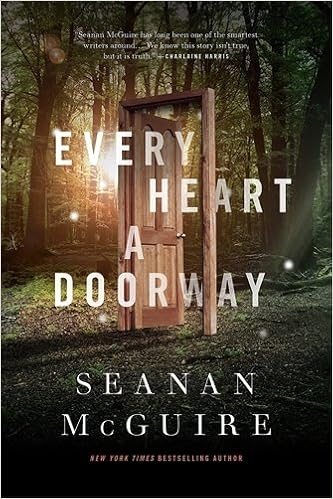
Book Review: Every Heart a Doorway

You may have noticed I've been posting more book reviews recently. In addition to analyzing data and writing, reading is one of the main ways I spend my time, down- or otherwise. This year, I've challenged myself once again to read 48 books. I'm already 4 books in and it's only January 16. I've also had some pesky insomnia recently, so reading is one of the things I do when I can't sleep. But I've mostly been reading short books so far, so I know that rate will decrease once I get to some of the much longer books on my list.

Which brings us to the book I just finished last night, Every Heart a Doorway by Seanan McGuire. Another instance of young adult fantasy, which I discovered in my first Goodreads data analysis, is the only kind of young adult books I read.


The book takes place at a Home for Wayward Children. While the headmistress, Eleanor West, tells the family of these children that she will help heal their children of their delusions about other magical worlds, in actual fact, her school is a place for children who have stepped into a magic world of some kind and then have to deal with the heartbreak of being expelled from it for one reason or another. That's right, these are the children that ended up in places like Narnia or Oz (though only Narnia is brought up in the book, and dismissed as fiction), after stepping or being pulled through some kind of magical doorway.

Each child is broken in some way and longs to return to their magical world, or at least, longs to deal with the pain of being thrown out. The story starts when Nancy is sent to the school by her parents, after having disappeared into the Land of the Dead and returned much later with a strange tale about where she had been. She is paired with the bubbly Sumi, who spent her time in a High Nonsense world, as her roommate. There, Nancy learns that the magical worlds use a different kind of compass, one where the major coordinates are Nonsense, Logic, Virtue, and Wickedness, in place of North, South, East, and West, and that each child returns from their world changed. She hopes to simply fit in at the school, but then one of her classmates dies. As a former resident of the Land of the Dead, some of the suspicion falls on Nancy. She and her newfound friends try to find out what is happening and who is responsible.

The book (a novella) is a quick read and beautifully written. Seanan's prose is very poetic and thought-provoking at times. As she gets farther into the story, and begins the murder mystery angle, her prose becomes a bit more descriptive and less poetic. I'm not terribly surprised that Every Heart a Doorway has won so many awards. But I have to say, I was a bit disappointed when she made that shift to more descriptive writing, because I was really enjoying the beauty and wordplay.

The story of children being taken to magical worlds suited to their underlying personality traits is an apt metaphor for difficulty "fitting in" experienced by so many children and teenagers. But Seanan also takes on topics teenagers (and adults) struggle through, like sexuality and gender identity directly.

I'll definitely be checking out Seanan's other books, including the two other Wayward Children books.

Monday, January 15, 2018

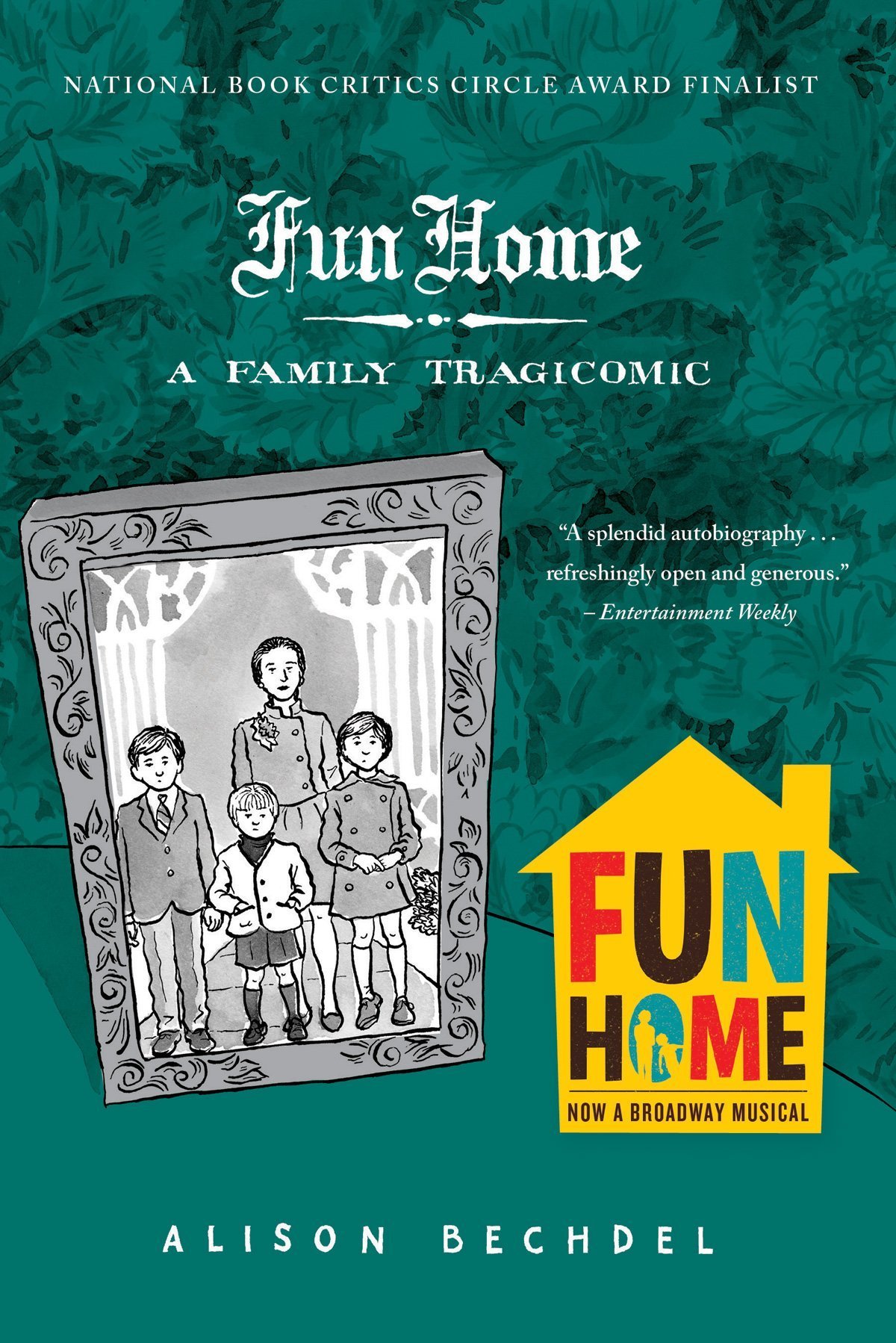
Book Review: Fun Home

Over the weekend, I read Fun Home by Alison Bechdel. This graphic novel is Alison's memoir, describing her upbringing in rural Pennsylvania, her family but particularly her relationship with her closeted father, Bruce, and her own coming out.


The story is nonlinear, with each chapter exploring different themes while often covering large spans of time. But much of the focus is on the fact that (and this is stated very early in the book, so it's not completely a spoiler) Alison's father died after stepping in front of a truck (which she concludes was purposeful) not long after Alison came out to her family, learned her father had had affairs with men (and boys), and introduced the family to her girlfriend, Joan.

Alison feels responsible for her father's death, that he killed himself not because his daughter is a lesbian, but because she was able to do something he never had the courage to do: come out. Instead, he focuses his energy on restoring his Victorian home, reading and discussing literature, and taking his frustrations and anger that he isn't living the life he wants out on his family. The name of the story, Fun Home, not only references the nickname given to the family business (a funeral home) but also ironically refers to the atmosphere Bruce created ruling over the house like a tyrant.

The story was adapted into a musical, which I saw last year and absolutely loved. At the performance, I bought a copy of the book, which has been languishing on one of my to-read shelves for too long. It's a quick read, so if you're looking for a great story you can finish over a weekend, I highly recommend it. Because I'd seen the musical first, I couldn't help but compare to the original and decide what I thought of the adaptation. The play really does justice to the graphic novel, hitting most of the high points while maintaining Alison's story that shifts seamlessly back and forth between comedy and tragedy.

But the book really goes beyond the play in drawing multiple parallels with the literature Bruce loved: the story of the Minotaur and the labyrinth, which Alison compares to the labyrinthine home Bruce creates, to hide himself within; James Joyces's Ulysses; Oscar Wilde's The Importance of Being Earnest; and the writings of F. Scott Fitzgerald, Henry James, Albert Camus (particularly A Happy Death and The Myth of Sisyphus), William Shakespeare, and Marcel Proust. She also makes various pop culture references, such as It's a Wonderful Life. In fact, the way she could weave together tragedy and comedy has many parallels to Shakespearean plays, where the death of the king (in this case, Bruce the tyrant) is followed with a comedic scene. There were so many wonderful metaphors and themes that couldn't really be easily adapted into the play. Also, the play completely leaves out Alison's struggles with obsessive-compulsive disorder, which explains some of her quirks and behavioral patterns that were in the play.

Though the play doesn't really develop many of the characters beyond Alison and Bruce, the book gives a little more attention and development to the other characters (but still not much, relatively speaking). I'd love to hear Alison explore her relationships with her mother and siblings, though it would make more sense to do that in different work(s). And to be fair, she may have already done this; I just need to explore her work more. Prior to learning about Fun Home, my awareness of Alison Bechdel was in the form of the Bechdel test (which I've blogged about here, and in film reviews here and here).

Overall, a quick read that will make you think, laugh, and cry. As someone who has experienced a family suicide, some of those themes were particularly difficult for me, so keep that in mind if that's also a potential trigger for you.

Friday, January 12, 2018

Book Review: The Ghost: A Cultural History

Through pictures, poems, ballads and stories we are able to watch the British ghost as it changes from violent revenant to suffering soul, from admonitory corpse to demonic illusion, from moral teacher to visual spectacle, from historical ambassador to translucent spectre, from fearsome presence to reassuring historical spirit. In whatever ways ghosts choose to manifest themselves in reality, it is in the imagination that they have the most varied and revealing existence. It is here that ghosts hold up a mirror to us, one that reveals our desires and fears.
The Ghost: A Cultural History by Susan Owens, p. 269

I just finished tearing through The Ghost. (I blogged about this book shortly after I first learned about it, so it's great to follow-up with a review.) Though Owens first introduces us to the subject of ghosts with one of the most famous examples in literature - Marley's Ghost in A Christmas Carol - she quickly takes us back to the year 1014, with a story of an attack on (and death of) the Danish conqueror Sweyn Forkbeard by East Anglican king, St. Edmund, who died in 869. From there, Owens takes us through the history of ghosts: how they are portrayed and thought of in both fictional and nonfictional stories.

In the past, ghosts dolled out punishment to wrong-doers, serving as a sort of karmic balance. In some regards, that isn't too different from our conception of ghosts in popular culture - people who died through some injustice or with important business unfinished. But the way ghosts could manifest themselves changed drastically over the centuries. Prior to the Protestant Reformation, ghosts were often souls that had escaped (temporarily) from purgatory, and were asking anyone they encountered to pray for them so they could be released. The Reformation changed that by doing away with the idea that souls went to purgatory, rather than directly to heaven or hell. Early ghosts were also basically zombies - they were corporeal and solid and could be/were mistaken for the living at times.

During this time, attire of ghosts also changed, from death shrouds and white billowy fabric (sheets, anyone?), to clothing they were seen wearing when they were alive.

Ghosts were also inextricably linked to technology. Ghosts went from being solid and corporeal to ethereal and translucent around the time entertainers figured out how to put on light shows that projected reflected images of actors - images that were ethereal and translucent. Painting also influenced this conception, with the switch from oil paint to water colors.

As technology advanced, giving us telegraphs and electricity, ghosts also changed form. Authors imagined telegraphs and phone calls from ghosts, and today's ghost hunters insist that ghosts give off electromagnetic fields that can be picked up with EM monitors. They look for ghostly messages in television static and EVP. Over and over, the book challenged things I had even accepted as standard folklore. In fact, the tendency for horror movies to punish people who disobey social norms comes from the influence of Victorian ghost stories - a time period when stories were easily obtained and thus very popular, and a period of supernatural tales that was revisited beginning in the 1950s.

But at the heart of the book is why we find ghosts so fascinating and enduring. Though our belief in other supernatural beings, like vampires, evil witches who sold their souls to the devil, and demonic possession as an explanation for physical illnesses, have thankfully changed over the centuries, one could argue that ghosts are as much an enduring belief today as they were then. I don't want to give away too much, since I highly recommend you check out this book for yourself, but the big takeaway I got from the book is that ghosts are an enduring belief because the past is always there - not just in our memories but as a physical presence, in the form of old houses, ancient structures, and dark forests. Every person who has ever lived is still on this earth in some form. And people leave a mark on the places they've been and the people they interact with.

My one complaint is that the book was a bit slow at the beginning, or rather, I was slow to get into it when I first started. It felt as though she jumped from her own narrative to quotes far too often, and I wanted to hear more about her own thoughts and analysis. But once I got about 10-25% of the way through, I found I had fallen into a nice rhythm and had come to appreciate her blending of literary quotes with analysis and commentary. So if you also find it to be a slow read at first, try to push through and I think you'll enjoy it as much as I did.

Friday, January 5, 2018

Teamwork and the Reproducibility Problem

It has been known for some time that psychology has a reproducibility problem, though we may not always agree on how to handle or discuss these issues. I remember chatting with another researcher at a conference shortly after I finished my masters thesis on stereotype threat and its impact on math performance in women. I had failed to replicate stereotype threat effects in my study. She, on the other hand, said her effects were incredibly strong; she described a participant experiencing a panic attack when she was told she had to do math problems, and had even noticed her female participants' math performance was negatively affected when her research assistant had been knitting during the session. (I also remember a reviewer telling me I must have performed the study poorly, not because the reviewer found any flaws in my methods, but because I had failed to reproduce the stereotype threat effects in my research.)

Efforts to handle this crisis thus far have included making psychological research more transparent and large-scale meta-analyses. And a new effort is already underway to harness the power of multiple research labs across the world: the Psychological Science Accelerator. Christie Aschwanden of FiveThirtyEight has more:
[Psychologist Christopher] Chartier, a researcher at Ashland University, doesn’t think massively scaled group projects should only be the domain of physicists. So he’s starting the “Psychological Science Accelerator,” which has a simple idea behind it: Psychological studies will take place simultaneously at multiple labs around the globe. Through these collaborations, the research will produce much bigger data sets with a far more diverse pool of study subjects than if it were done in just one place.

The accelerator approach eliminates two problems that can contribute to psychology’s much-discussed reproducibility problem, the finding that some studies aren’t replicated in subsequent studies. It removes both small sample sizes and the so-called weird samples problem, which is what happens when studies rely on a very particular population — like relatively wealthy college students from Western countries — that may not represent the world at large.

So far, the project has enlisted 183 labs on six continents. The idea is to create a standing network of researchers who are available to consider and potentially take part in study proposals, Chartier said. Not every lab has to participate in any given study, but having so many teams in the network ensures that approved studies will have multiple labs conducting their research.
According to the blog, the Psychological Science Accelerator is taking on its second study, this one on gendered social category representation. And if you're attending the Association for Psychological Science meeting in May, you can check out a symposium on "Large Scale Research Collaborations: Applications in Crowd-Sourcing and Undergraduate Research Experience, Replications, and Cross-Cultural Research." (Day and time TBD - APS is still finalizing the program, and is still accepting poster submissions through the end of this month.)

Thursday, December 21, 2017

Decoding Fowl Language

The University of Georgia and Georgia Institute of Technology recently collaborated on a fascinating project - using AI to decode chicken language:
In a series of studies published between 2014 and 2016, Georgia Tech research engineer Wayne Daley and his colleagues exposed groups of six to 12 broiler chickens to moderately stressful situations—such as high temperatures, increased ammonia levels in the air and mild viral infections—and recorded their vocalizations with standard USB microphones. They then fed the audio into a machine-learning program, training it to recognize the difference between the sounds of contented and distressed birds.

“It’s really interesting work, fairly ingenious and logical,” says Wallace Berry, a poultry scientist at Auburn University’s College of Agriculture who was not involved in the studies. “Chickens are a very vocal species, and as a poultry farmer you can always use more data to make better decisions. This is a great way to continuously filter all the information available in a chicken house and learn as soon as possible that something is wrong.”
Next step - learn how to speak to chickens, and ask them the question we've asking for years:

Tuesday, December 19, 2017

Movie Review: The Disaster Artist

It's been a while since I've done a movie review and I just saw The Disaster Artist last night - so here we are! A movie review, and not even a superfluous one at that.


The Disaster Artist tells the story of Tommy Wiseau (played by James Franco) and his best friend/fellow actor Greg Sestero (Dave Franco), as they try to make it in the crazy world of show business. Tommy has a mysterious past: no one knows how old he is, where he's from (he claims to be from New Orleans despite an unidentified/unidentifiable Eastern European accent), or where his vast wealth comes from.

Tommy and Greg meet in Jean Shelton's acting class, where Jean (in a great cameo from Melanie Griffith) offers both actors feedback after poorly executed scenes. Despite the fact that Tommy's rendition of Tennessee Williams's A Streetcar Named Desire was simply him shouting, "Stella!" over and over again while climbing the walls and writhing on the floor, Greg is impressed with Tommy's fearlessness. He asks Tommy to do a scene with him. Tommy encourages Greg to overcome his stage fright, and their friendship is born.

Together they move to L.A., staying in an apartment Tommy owns but rarely visits. They go through the various steps of becoming professional actors: taking headshots, going to auditions, and (at least in Greg's case) finding an agent - the great Iris Burton (another great cameo, this one by Sharon Stone), who is famous for representing child actors like River Phoenix, Kirsten Dunst, Drew Barrymore, and Fred Savage.

But despite all that, Tommy and Greg both struggle to get cast. Greg laments that maybe they should just make their own movie. Tommy, with his "bottomless" bank account, thinks that's a great idea, and writes a screenplay for The Room. When Tommy makes the unbelievable decision to purchase, rather than rent, cameras and equipment, he is given access to a studio and some of the best technicians in show business to help him make his movie. And, as history has shown us, that awful, incoherent movie went on to become a cult film, playing to sold out crowds.

The Disaster Artist does for The Room what Ed Wood did for Plan 9 From Outer Space - the "so bad it's good" movie that was already loved by many gets elevated and understood at a new level. The story behind the movie helps you to appreciate, even admire, the movie, regardless of its inept writing and poor execution. In fact, I'm a fan in general of "making of" movies, like Shadow of a Vampire (portraying the making of Nosferatu) and RKO 281 (portraying the making of Citizen Kane); regardless of whether the movie they portray is a masterpiece (as Nosferatu and Kane are considered to be) or garbage (like The Room and Plan 9) these making-of films are like love letters to the original movies and to cinema in general.

I'm about halfway through the book on which The Disaster Artist is based, written by Greg Sestero and author Tom Bissell, both of whom have cameos in this movie. (Also, be sure to hang around after the credits for a great scene with the real Tommy Wiseau.) So it's difficult for me not to compare the book and the movie, and - as is so often the case - feel bummed that they cut out some great parts from the book. For the most part, I felt this was a good adaptation of the source material, and fit a lot of Greg's and Tom's insights into The Room and Tommy himself into the movie. The beginning, though, felt a bit rushed - I didn't feel like it established why Greg and Tommy became friends, and why Greg was willing to do and give up so much to make Tommy happy. But the actors in the film all did an excellent job at bringing the material to life. James Franco was incredible as Tommy, and Dave Franco perfectly captured Greg's sweet, naïve charm.

Probably the part I'm most bummed they cut out was Greg's story about the movie Home Alone. In the film version, Greg shares that he became interested in acting because Home Alone changed his life. It's a throwaway line that makes Greg look like a lovable idiot. But in the book, he explains what he means by that, and it's actually a really sweet story. After Greg saw Home Alone, he went home and wrote a screenplay for Home Alone 2. Greg, being a child at the time (he's about my age), probably didn't write a professional-quality screenplay, but nonetheless, he found the address for John Hughes's production company, and sent his screenplay in. Not long after, he got his screenplay back in the mail, along with a note from John Hughes, telling him: "Believe in yourself, have patience, and always follow your heart." He says after reading that note, he found his calling.

Having seen The Room helps to understand many of the funny moments in The Disaster Artist. I'm fairly certain the others in theatre with me had never seen The Room because I was often the only laughing. But regardless of whether you've seen The Room, I highly recommend checking The Disaster Artist out. And if you're a fan of The Room or just bad movies in general, I also highly recommend reading the book.

Friday, December 15, 2017

The Power of the Human Voice

Human beings are drawn to the sound of human voices. It's why overhearing half of a conversation can be so distracting. It's why DJs will talk over the intro of the song, but make sure they stop before the singer comes in. It's why Deke Sharon and Dylan Bell, two a cappella arrangers, recommend arrangements be kept short (less than 4 minutes).

And new research shows yet another way a human voice can have a powerful impact - it keeps us from dehumanizing someone we disagree with:
[F]ailing to infer that another person has mental capacities similar to one’s own is the essence of dehumanization—that is, representing others as having a diminished capacity to either think or feel, as being more like an animal or an object than like a fully developed human being. Instead of attributing disagreement to different ways of thinking about the same problem, people may attribute disagreement to the other person’s inability to think reasonably about the problem. [W]e suggest that a person’s voice, through speech, provides cues to the presence of thinking and feeling, such that hearing what a person has to say will make him or her appear more humanlike than reading what that person has to say.
They conducted four experiments to test their hypotheses: that dehumanization is less likely to occur when we hear the person speaking their thoughts, rather than simply reading them. It wasn't even necessary to see the person doing the talking - that is, video and audio versus audio only did not result in reliably different evaluations. The authors conclude:
On a practical level, our work suggests that giving the opposition a voice, not just figuratively in terms of language, but also literally in terms of an actual human voice, may enable partisans to recognize a difference in beliefs between two minds without denigrating the minds of the opposition. Modern technology is rapidly changing the media through which people interact, enabling interactions between people around the globe and across ideological divides who might otherwise never interact. These interactions, however, are increasingly taking place over text-based media that may not be optimally designed to achieve a user’s goals. Individuals should choose the context of their interactions wisely. If mutual appreciation and understanding of the mind of another person is the goal of social interaction, then it may be best for the person’s voice to be heard.

This research inspires some interesting questions. For instance, what about computer-generated voices? We know we're getting better at generating realistic voices, but what is the impact when you know the voice is generated by a machine and not another human being? Also, the researchers admit that they couldn't test the impact of visual and audio cues separately. But what if you had an additional condition where you see the person, but their words are displayed as captions instead?

What are your thoughts on this issue? And where would you like to see this research go in the future?