Here we are at the end of A-Z, so what better way to end it than by discussing one of the most influential social psychologists, Robert Zajonc (pronounced Zah-yuntz).
His contributions to the subfield are numerous, and he is apparently the 35th most cited psychologist of the 20th century. Some even state that he is one of the "creators" of modern social psychology, and his work is certainly partially responsible for the shift to "cognitive" social psychology. One of his best known contributions is the mere exposure effect, but much of his work is linked to this concept, in its focus on how presence of and exposure to others changes us cognitively and even physically.
The mere exposure effect deals with the attitude change that naturally occurs as something/someone becomes more familiar to us. That is, as we continue to be exposed to a person, place, or object, our attitude naturally becomes more positive. Once again, this simple concept has many important applications, but one of the most striking is in using the mere exposure effect to improve relations with certain groups, such as groups that are often the target of prejudice and discrimination. Having friends who are of different races, sexual identities, and so on, reduces your feelings of prejudice toward those groups. This finding offers an important rationale for the need for diversity in schools and workplaces.
Zajonc also studied social facilitation, finding that it occurs not just in humans, but animals and even cockroaches. And he and a colleague (Greg Markus) are also known for the Confluence Model, which deals with birth order and intelligence. According to this theory, first-born children are more intelligent, because they are born into adult-only environments, and also, if they eventually have younger siblings, they are involved in teaching those children. Last-born children are born into the most mixed adult-child environment, and also do not have the opportunity to teach younger children, resulting in lower intelligence. However, the magnitude of this impact on intelligence tests is small, about 0.2 standard deviations.
What many of his research has in common is the focus on cognition, but also on how affect (emotion) comes into play. This work culminated in his address for the Distinguished Scientific Contribution Award from the American Psychological Association: Feeling and Thinking, Preference Needs No Inferences. You can read the address/article for free at the link, but in short, Zajonc found that cognition and affect are two separate systems, but affect is more influential and experienced first. Cognition - the more systematic, rational approach - takes time and mental energy. Emotions are often automatic.
Because we're cognitive misers, we tend to gravitate toward the easy approach when making decisions, so we often let our emotions guide us. As I wrote in the Quick v. Slow post this month, decisions made through this faster, automatic channel are not necessarily wrong, nor are decisions made through the slower, systematic channel necessarily right. They are simply different approaches to a problem, and the proper approach really depends on the situation. However, social psychology as a field had started to focus too heavily on cognition, avoiding affect or emotion, which gave an incomplete understanding of social psychological concepts. Zajonc's work encouraged researchers to once again consider affect in their work.
Hope you've enjoyed A-Z!
Saturday, April 30, 2016
Friday, April 29, 2016
Y is for "You Are Not So Smart"
I was midway into teaching a course in Learning & Behavior when one of my favorite students came up to me and simply said, "You are not so smart."
I must have noticeably paused, wondering where he was going with this, when he got a look of total embarrassment on his face and said, "No, I mean, that's the name of a book I think you would love. You Are Not So Smart. I don't mean you're not smart."
I laughed and thanked him for his recommendation, and immediately added the book to my wishlist. As I was doing some additional research, I learned that not only is You Are Not So Smart a book, it's also a website and a series of podcasts, all about the various cognitive biases humans experience.
So my student was right - I love You Are Not So Smart. And also, I am not so smart. But that's okay, because the same is true for everyone.
The book/website/podcasts are all about the various ways we delude ourselves. This includes, for instance, self-enhancement biases - ways in which we make ourselves seem better than we are. The Dunning-Kruger effect is a great example. It also includes simply skewed perception, such as our tendency to rewrite our memories to make them fit with our current identity.
On the flipside, it can also include self-deprecating biases, like impostor syndrome, and self-handicapping, like learned helplessness. Humans are complex creatures, after all.
The great thing about You Are Not So Smart is that it is incredibly approachable, even for people with little to no knowledge of psychology, and it clearly explains and applies this information, with lots of pop culture references sprinkled in. David McRaney, the man behind You Are Not So Smart, skillfully does what I hope to do with this blog, and he's a great role model for my own writing.
So be sure to check out You Are Not So Smart. If you enjoy it as much as I do, be sure to check out his follow-up book - which I'm embarrassed to say I just learned about - You Are Now Less Dumb!
I must have noticeably paused, wondering where he was going with this, when he got a look of total embarrassment on his face and said, "No, I mean, that's the name of a book I think you would love. You Are Not So Smart. I don't mean you're not smart."
I laughed and thanked him for his recommendation, and immediately added the book to my wishlist. As I was doing some additional research, I learned that not only is You Are Not So Smart a book, it's also a website and a series of podcasts, all about the various cognitive biases humans experience.
So my student was right - I love You Are Not So Smart. And also, I am not so smart. But that's okay, because the same is true for everyone.
The book/website/podcasts are all about the various ways we delude ourselves. This includes, for instance, self-enhancement biases - ways in which we make ourselves seem better than we are. The Dunning-Kruger effect is a great example. It also includes simply skewed perception, such as our tendency to rewrite our memories to make them fit with our current identity.
On the flipside, it can also include self-deprecating biases, like impostor syndrome, and self-handicapping, like learned helplessness. Humans are complex creatures, after all.
The great thing about You Are Not So Smart is that it is incredibly approachable, even for people with little to no knowledge of psychology, and it clearly explains and applies this information, with lots of pop culture references sprinkled in. David McRaney, the man behind You Are Not So Smart, skillfully does what I hope to do with this blog, and he's a great role model for my own writing.
So be sure to check out You Are Not So Smart. If you enjoy it as much as I do, be sure to check out his follow-up book - which I'm embarrassed to say I just learned about - You Are Now Less Dumb!
Thursday, April 28, 2016
X is for Factorial (X) Design
The simplest study has two variables: the independent variable (X), which we manipulate, and the dependent variable (Y), the outcome we measure. The simplest independent variable has two levels: experimental (the intervention) and control (where we don't change anything). We compare these two groups to see if our experimental group is different.
To use a recent example, if we want to study the Von Restorff effect, we would have one group with a simple list (control) and another group with one unusual item added to the list (experimental). We would then measure memory for the list.
But we don't have to stop at just one independent variable. We could have as many as we would like. So let's say we introduced another variable from a previous post: social facilitation. Half of our participants will complete the task alone (no social facilitation) while the other half will compete with other participants (social facilitation).
When we want to measure the effects of two independent variables, we need to have all possible combinations of those two variables. This is a factorial (also known as a crossed) design. We figure out how many groups we need by multiplying the number of groups for the first variable (X) by the number of groups for the second variable (Z).
For the example I just gave, this would be a 2 X 2 design. The X would be pronounced as "by." This gives us a total of 4 groups: unique item-no social facilitation, simple items-no social facilitation, unique items-social facilitation, and simple items-social facilitation. Only by having all possible combinations can we separate out the effects of both variables.
Not only does this design require us to have more people and often more study materials, it requires us to have more hypotheses: predictions about how the study turns out.
We would have one hypothesis for the first independent variable: lists that contain unique items will be more memorable than simple lists. And another for our second independent variable: participants who compete against others will remember more list items than people who do not compete against others.
But we would also have a hypothesis about how the two variables interact. Since we expect people with unique lists and social facilitation groups to perform better (remember more items), we might expect people with both unique lists and social facilitation to have the best performance. And on the opposite end of the spectrum, we might expect people who receive simple lists with no social facilitation to perform poorest.
We might also think that unique lists alone (no social facilitation) and social facilitation (no unique items) alone will produce about the same performance. So we would hypothesize that these two groups will be about the same. We would then run our statistical analysis to see if we detect this specific pattern.
The great thing about this design is that we don't have to use it with two manipulated variables. We could have one of our variables be a "person" variable: a characteristic about the person we can't manipulate. For example, one variable could be gender. This changes our design from "experimental" to "quasi-experimental."
For my masters thesis, I studied a concept know as stereotype threat, which occurs when a stereotype about a group affects a group member's performance. I looked at how stereotype threat affects women's math performance. So one of my variables was manipulated (stereotype threat) and the other was gender. This is a common design for examining gender differences.
Wednesday, April 27, 2016
W is for John Watson
John Watson, an American psychologist, was responsible for the establishment of behaviorism, which had a stronghold in the field of psychology for many decades.
This was in part due to the methods available to study people - the only way we could observe what happens within a person's brain was by asking them how they were feeling, what they were thinking, and so on. Behaviorists determined that because the only thing we could observe was behavior, that should be the only thing we measure. Taken to its extreme is the stance that observable behavior is everything, thought and feelings essentially don't exist, and the only factors affecting behavior are external to the person. This particular school of thought is often called "radical behaviorism."
I could go on for a while about Watson, thanks to the fact that I was briefly brainwashed by behaviorists in undergrad. My undergraduate program had a very strong behaviorist slant, I had a pet rat (a baby of two of the rats from our rat lab), and I even took an entire course devoted to B.F. Skinner. So I was walking around spouting about a variety of behaviorist concepts, including Watson's "tabula rasa" or "blank slate." Essentially, what this concept means is that, when we are born, our mind is a blank slate - Watson and other radical behaviorists did not believe that babies were born with any semblance of a personality. All behavior is learned from the environment. That is, radical behaviorism is a deterministic model: it denies the existence of free will. In fact, Watson once said:
Every time Albert encountered the white rat, Watson would make sudden loud noises. Over time, Albert began to show fear toward the white rat. But it didn't stop there. Albert was afraid of anything white and furry, including bunnies and a Santa Claus mask. Now, for his next study, Watson was going to undo the fear conditioning he introduced to poor Albert, but Albert moved away before that study could be completed. Though people tried to track down Little Albert later on - to see if there was a man with an irrational fear of white furry things out there - his true identity has not been confirmed.
This was in part due to the methods available to study people - the only way we could observe what happens within a person's brain was by asking them how they were feeling, what they were thinking, and so on. Behaviorists determined that because the only thing we could observe was behavior, that should be the only thing we measure. Taken to its extreme is the stance that observable behavior is everything, thought and feelings essentially don't exist, and the only factors affecting behavior are external to the person. This particular school of thought is often called "radical behaviorism."
I could go on for a while about Watson, thanks to the fact that I was briefly brainwashed by behaviorists in undergrad. My undergraduate program had a very strong behaviorist slant, I had a pet rat (a baby of two of the rats from our rat lab), and I even took an entire course devoted to B.F. Skinner. So I was walking around spouting about a variety of behaviorist concepts, including Watson's "tabula rasa" or "blank slate." Essentially, what this concept means is that, when we are born, our mind is a blank slate - Watson and other radical behaviorists did not believe that babies were born with any semblance of a personality. All behavior is learned from the environment. That is, radical behaviorism is a deterministic model: it denies the existence of free will. In fact, Watson once said:
Give me a dozen healthy infants, well-formed, and my own specified world to bring them up in and I’ll guarantee to take any one at random and train him to become any type of specialist I might select—doctor, lawyer, artist, merchant-chief and, yes, even beggar-man and thief, regardless of his talents, penchants, tendencies, abilities, vocations, and race of his ancestors.In one of Watson's best known studies, he shaped a baby to be afraid of something he had originally loved. This controversial study was known as the "Little Albert" experiment. "Albert" (not his real name) loved white rats; at least, they discovered that he loved white rats when they introduced him to one, along with various objects, to try to decide what to shape the boy to be afraid of (yes, really). That is, Watson was trying to prove that humans were not born with many fears; nearly all fears are shaped by the environment. What humans are naturally afraid of are loud noises. So, Watson decided to use loud noises to condition Albert to be terrified of the white rat.
Every time Albert encountered the white rat, Watson would make sudden loud noises. Over time, Albert began to show fear toward the white rat. But it didn't stop there. Albert was afraid of anything white and furry, including bunnies and a Santa Claus mask. Now, for his next study, Watson was going to undo the fear conditioning he introduced to poor Albert, but Albert moved away before that study could be completed. Though people tried to track down Little Albert later on - to see if there was a man with an irrational fear of white furry things out there - his true identity has not been confirmed.
Tuesday, April 26, 2016
V is for Hedwig von Restorff
Many people going into psychology in recent decades are women. In fact, it is quickly becoming a woman-dominated field. Unfortunately, many of the well-known scholars and researchers in psychology, including social psychology, are men. I've blogged about gender issues before, talking about topics like representation of women in the STEM fields and perceptions about ability based on gender. So for today's topic, I wanted to feature a woman who made an important contribution to the field.
Hedwig von Restorff was a German psychologist, trained in the Gestalt tradition. Gestalt psychology can be summed up as "the whole is greater than the sum of its parts" (though interestingly, the original quote actually translates to "the whole is other than the sum of its parts"). That is, Gestalt psychologists focus on overall constructs, and how people perceive individual pieces as part of a whole. They also study topics like pattern recognition, and even biases in perceiving patterns and order where they do not exist. It goes back to the idea that humans like order, and will perceive the world in such a way as to bring order to chaos.
Unfortunately, we don't a lot about Restorff's contributions to the field of psychology, because much of her work was never translated into English. However, she is best known for the isolation paradigm, also known as the Von Restorff effect. This occurs when we remember an object or item in a list better because it is unusual.
Though this seems like a very simple concept, it has widespread applications. It is frequently applied to advertising, which is perhaps one reason why advertising can seem very off-the-wall and random. Marketers have to do something different to set themselves apart. As other marketers do the same thing, "weird" becomes the new normal, so marketers have to keep pushing the envelope to make their product, or at least its advertising, seem different.
This concept can also work in concert with other cognitive biases, like the availability heuristic, where something seems common or likely because it is easily remembered. This might explain why people tend to focus on rare events of a behavior instead of more common outcomes. For instance, among people who are anti-vaccination, this would explain why they focus on the rare serious side effects that can occur from vaccination, as opposed to the more common illness that comes along with not not being vaccinated. The serious side effects, like Guillain–BarrĂ© syndrome is memorable, because it is so unusual. But your odds of having that side effect are ridiculously small: about 1 in 1 million.
This is still an important area of research today. Restorff's legacy lives on.
Hedwig von Restorff was a German psychologist, trained in the Gestalt tradition. Gestalt psychology can be summed up as "the whole is greater than the sum of its parts" (though interestingly, the original quote actually translates to "the whole is other than the sum of its parts"). That is, Gestalt psychologists focus on overall constructs, and how people perceive individual pieces as part of a whole. They also study topics like pattern recognition, and even biases in perceiving patterns and order where they do not exist. It goes back to the idea that humans like order, and will perceive the world in such a way as to bring order to chaos.
Unfortunately, we don't a lot about Restorff's contributions to the field of psychology, because much of her work was never translated into English. However, she is best known for the isolation paradigm, also known as the Von Restorff effect. This occurs when we remember an object or item in a list better because it is unusual.
![]() |
| Either a demonstration of this effect, or a Prog Rock album cover - you be the judge. |
Though this seems like a very simple concept, it has widespread applications. It is frequently applied to advertising, which is perhaps one reason why advertising can seem very off-the-wall and random. Marketers have to do something different to set themselves apart. As other marketers do the same thing, "weird" becomes the new normal, so marketers have to keep pushing the envelope to make their product, or at least its advertising, seem different.
This concept can also work in concert with other cognitive biases, like the availability heuristic, where something seems common or likely because it is easily remembered. This might explain why people tend to focus on rare events of a behavior instead of more common outcomes. For instance, among people who are anti-vaccination, this would explain why they focus on the rare serious side effects that can occur from vaccination, as opposed to the more common illness that comes along with not not being vaccinated. The serious side effects, like Guillain–BarrĂ© syndrome is memorable, because it is so unusual. But your odds of having that side effect are ridiculously small: about 1 in 1 million.
This is still an important area of research today. Restorff's legacy lives on.
Monday, April 25, 2016
U is for Unobtrusive Measures
These past few posts have focused heavily on bias in methods - or rather, removing bias from the study through specific controls and research methods. One of the big topics for psychologists is finding out what people think about something. Obviously, asking them what they think is one way, but people are eager to please, and may answer in the way they think the researcher wants, rather than how they actually feel. Additionally, when you conduct opinion polls, there are guidelines about sample sizes, if you want your results to be representative of the larger group. For that reason, one of the big contributions in psychology is how to measure how people feel about something through observations or by measuring something related (what we call proxy measures). That is, we can find ways to measure people's opinions unobtrusively.
One of the best books on the topic is the aptly titled Unobtrusive Measures:
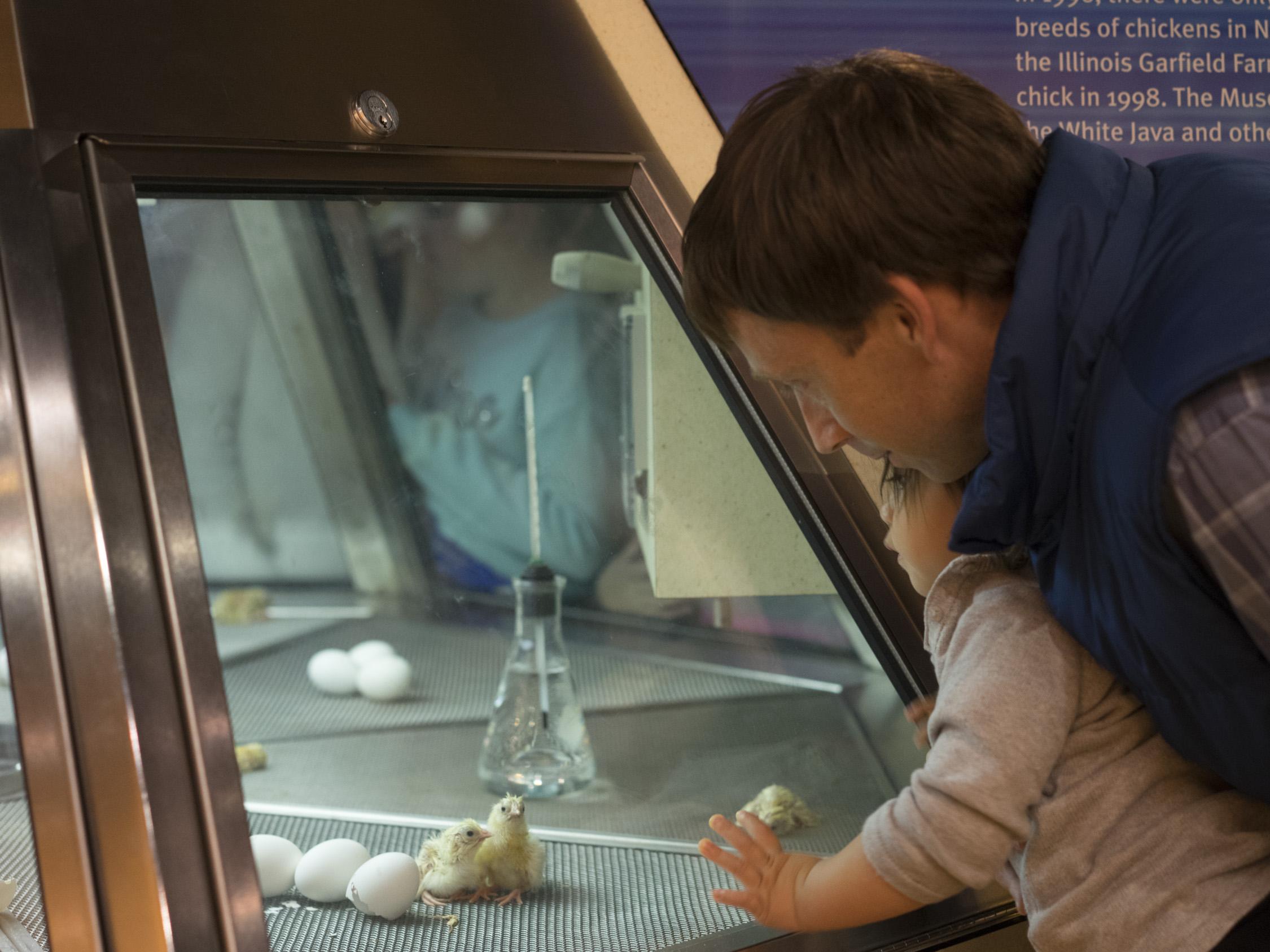
This book is full of some really crafty ways to measure what people think of something. My favorite methods described in the book are known as erosion methods. You can find out how much people like something (how much they stand or walk around that place) by looking at the erosion of flooring, steps, or stone. And the famous example of how this was used involved the Museum of Science and Industry (in Chicago) and a bunch of baby chicks.
This exhibit, known as the Hatchery, is one of the most popular exhibits at MSI. How do they know this? They had to replace the floor tiles around the exhibit every six weeks, whereas tiles in other parts of the museum are often not replaced for years. In fact, they could even rank the popularity of different exhibits based on how frequently the floor tiles are replaced. When combined with observation, they discovered that people spent longer amounts of time at the Hatchery than anywhere else in the museum. These two pieces of information could be obtained from repair records and a researcher standing by exhibits to observe how people behave. Much easier - and cheaper! - than fielding a survey with thousands of people.
One of the best books on the topic is the aptly titled Unobtrusive Measures:
This book is full of some really crafty ways to measure what people think of something. My favorite methods described in the book are known as erosion methods. You can find out how much people like something (how much they stand or walk around that place) by looking at the erosion of flooring, steps, or stone. And the famous example of how this was used involved the Museum of Science and Industry (in Chicago) and a bunch of baby chicks.
This exhibit, known as the Hatchery, is one of the most popular exhibits at MSI. How do they know this? They had to replace the floor tiles around the exhibit every six weeks, whereas tiles in other parts of the museum are often not replaced for years. In fact, they could even rank the popularity of different exhibits based on how frequently the floor tiles are replaced. When combined with observation, they discovered that people spent longer amounts of time at the Hatchery than anywhere else in the museum. These two pieces of information could be obtained from repair records and a researcher standing by exhibits to observe how people behave. Much easier - and cheaper! - than fielding a survey with thousands of people.
Saturday, April 23, 2016
T is for Norman Triplett
As I mentioned during my History of Social Psychology post, Norman Triplett is credited with having conducted the first experiment in social psychology, in which he examined an effect known as social facilitation.
Social facilitation occurs when you perform better when others are present than when you are alone. In his first study of the phenomenon, he noticed that cyclists were faster when someone else was riding with them than on their own. He decided to study this concept in the lab. He recruited 40 children, and had them turn fishing reels. He divided them into groups, where they alternated between performing the task individually or in competition with another child:
Group A: (1) alone, (2) competition, (3) alone, (4) competition, (5) alone, (6) competition
Group B: (1) alone, (2) alone, (3) competition, (4) alone, (5) competition, (6) alone
Interestingly, as I was doing some quick reading to refresh my memory, I discovered some new (to me) information about the study. An article by Stroebe (abstract here) included a reanalysis of the data and found differences between alone and competition performance, but none of these differences were significant. At the time Triplett conducted this study, he didn't have access to statistical analyses we have today, so he instead eyeballed the data. What statistical analyses do is remove guesswork and experimenter bias when examining results. We use controls while conducting the research to keep the experimenter from having an impact on participants, and giving them clues about how they are supposed to behave, but those controls are meaningless if we don't also have an unbiased way of analyzing the data.
We interrupt this blog post to give you a crash course in statistics. Statistics allow us to look for patterns in data, by examining differences in scores (which we call variation). Some variation is random, due to things like individual differences, fatigue, and so on; in Triplett's study, that would be the variation within the "alone" conditions or the "competition" conditions. This information tells us how much variation we will expect to see in scores by chance alone. Other variation is systematic, due to the experimental conditions; in Triplett's study, that would be the difference (variation in scores) between "alone" and "competition".
We compare these two types of variation to determine if our condition had an effect. If we see more of a difference between alone and competition (systematic) than we see by chance alone, we conclude that our experimental conditions had an effect. And our analyses give us a probability - that is the probability, if only chance were operating (no experimental effect), that we would see a difference between groups of that size.
Of course, I'm oversimplifying, but this is the basic premise of statistics. It might seem technical and unnecessary to some, but it keeps researchers honest. I mean, if you think you're going to see an effect, you devote time and energy into setting up and conducting the study, and then more time and energy into compiling your data, wouldn't you hope to see the effect you were expecting? To the point that you might see patterns that aren't actually there? As a field, we have agreed that we want as little bias as possible in conducting, analyzing, and reporting results, so we've developed methods, statistical analyses, and reporting standards to do just that.
To be fair to Triplett, he didn't have access to these statistical analyses at the time, so we'll forgive him for simply eyeballing the data. Further, more researchers have studied social facilitation and found support for it. In fact, this later research shows that social facilitation can occur in two ways: co-action (or competition, as Triplett studied) and audience.
In addition to social facilitation, Triplett also contributed to the psychology of magic - rather, what occurs in the perceiver watching a magician. This included concepts like misdirection and suggestibility. You can read the full-text of his article on the topic here.
Social facilitation occurs when you perform better when others are present than when you are alone. In his first study of the phenomenon, he noticed that cyclists were faster when someone else was riding with them than on their own. He decided to study this concept in the lab. He recruited 40 children, and had them turn fishing reels. He divided them into groups, where they alternated between performing the task individually or in competition with another child:
Group A: (1) alone, (2) competition, (3) alone, (4) competition, (5) alone, (6) competition
Group B: (1) alone, (2) alone, (3) competition, (4) alone, (5) competition, (6) alone
Interestingly, as I was doing some quick reading to refresh my memory, I discovered some new (to me) information about the study. An article by Stroebe (abstract here) included a reanalysis of the data and found differences between alone and competition performance, but none of these differences were significant. At the time Triplett conducted this study, he didn't have access to statistical analyses we have today, so he instead eyeballed the data. What statistical analyses do is remove guesswork and experimenter bias when examining results. We use controls while conducting the research to keep the experimenter from having an impact on participants, and giving them clues about how they are supposed to behave, but those controls are meaningless if we don't also have an unbiased way of analyzing the data.
We interrupt this blog post to give you a crash course in statistics. Statistics allow us to look for patterns in data, by examining differences in scores (which we call variation). Some variation is random, due to things like individual differences, fatigue, and so on; in Triplett's study, that would be the variation within the "alone" conditions or the "competition" conditions. This information tells us how much variation we will expect to see in scores by chance alone. Other variation is systematic, due to the experimental conditions; in Triplett's study, that would be the difference (variation in scores) between "alone" and "competition".
We compare these two types of variation to determine if our condition had an effect. If we see more of a difference between alone and competition (systematic) than we see by chance alone, we conclude that our experimental conditions had an effect. And our analyses give us a probability - that is the probability, if only chance were operating (no experimental effect), that we would see a difference between groups of that size.
Of course, I'm oversimplifying, but this is the basic premise of statistics. It might seem technical and unnecessary to some, but it keeps researchers honest. I mean, if you think you're going to see an effect, you devote time and energy into setting up and conducting the study, and then more time and energy into compiling your data, wouldn't you hope to see the effect you were expecting? To the point that you might see patterns that aren't actually there? As a field, we have agreed that we want as little bias as possible in conducting, analyzing, and reporting results, so we've developed methods, statistical analyses, and reporting standards to do just that.
To be fair to Triplett, he didn't have access to these statistical analyses at the time, so we'll forgive him for simply eyeballing the data. Further, more researchers have studied social facilitation and found support for it. In fact, this later research shows that social facilitation can occur in two ways: co-action (or competition, as Triplett studied) and audience.
In addition to social facilitation, Triplett also contributed to the psychology of magic - rather, what occurs in the perceiver watching a magician. This included concepts like misdirection and suggestibility. You can read the full-text of his article on the topic here.
Subscribe to:
Posts (Atom)